



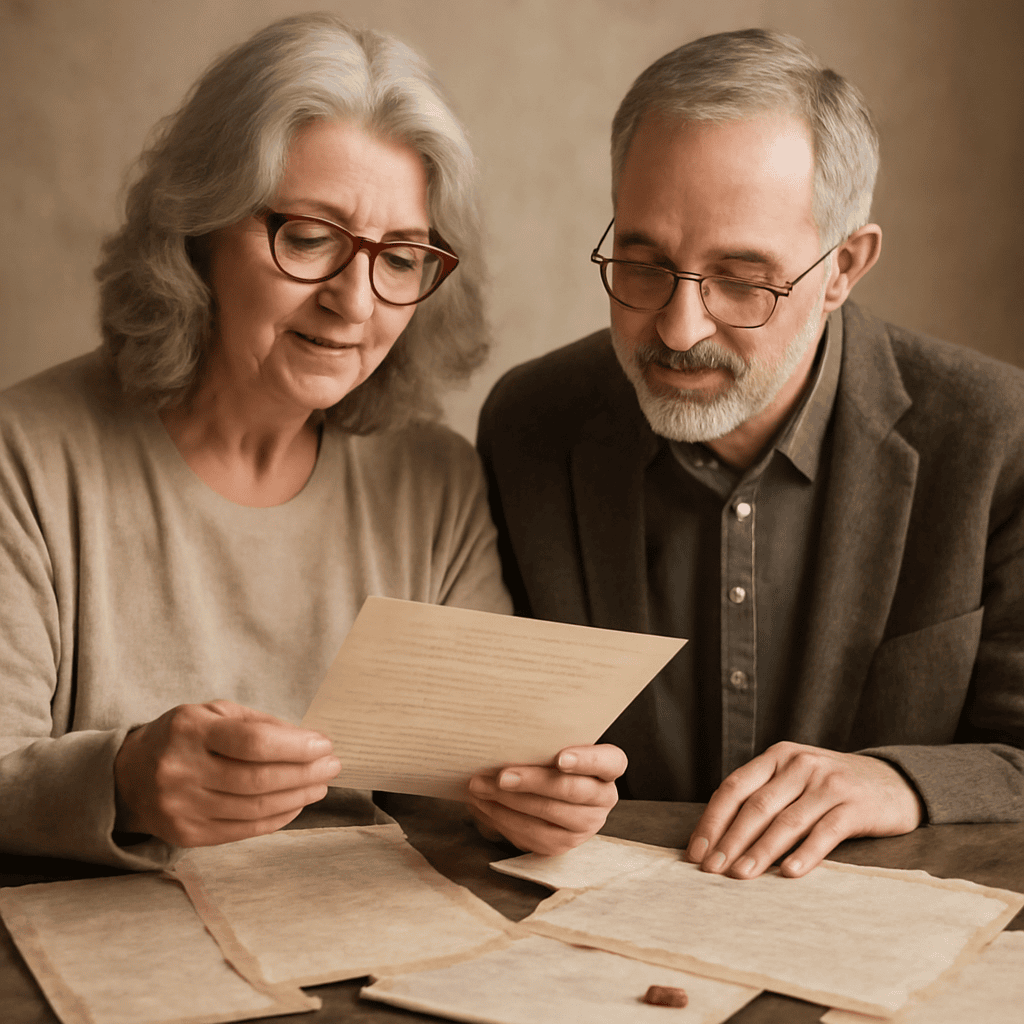
Why old letters and documents are valuable
Old letters and documents are more than just paper – they are witnesses to your family history and valuable memories that are priceless for your grandchildren. When you look at these documents together with your grandchildren, you not only give them insights into the past, but also a deeper understanding of their origins and roots. These shared moments create a special connection between generations and help your grandchildren better understand their own identity.
For your grandchildren, it is a unique experience to see the handwriting of their grandparents or great-grandparents, to read letters written many years ago, or to discover documents that record important events in family history. These documents make history tangible and personal – they show that the people from whom your grandchildren descend were real people with thoughts, feelings, and experiences. This connection to the past can help your grandchildren see themselves as part of a larger story and develop pride in their family.
Looking at old letters and documents together is also a wonderful opportunity to have conversations about values, traditions, and important life experiences. When you show your grandchildren how your family lived in the past, what challenges were overcome, and what joys were experienced, you give them valuable lessons for their own lives. These documents are not only memories of the past, but also lessons for the future – and your grandchildren will remember these experiences for the rest of their lives.
Keeping family history alive
Old letters and documents are living testimonies to your family history. They show how your family lived in the past, what events were important, and how life has changed over the generations. When you look at these documents together with your grandchildren, you help them understand and appreciate their family history. These documents are an important part of the heritage you can pass on to your grandchildren.
Each document tells a story – a letter from a family member reporting on an important event, a photo with a handwritten note on the back, a certificate or diploma testifying to a special moment in life. When you discover these stories together with your grandchildren, you make family history tangible and personal. Your grandchildren learn not only facts about their family, but also get to know the people behind these facts.
The joint engagement with old documents can also lead to your grandchildren asking questions you may never have answered. These conversations are valuable opportunities to learn more about your family and share memories that might otherwise be lost. By looking at these documents together, you help your grandchildren understand and appreciate their family history, while giving them the opportunity to preserve this history for future generations.
Creating connections between generations
Old letters and documents create a special connection between generations. When you look at these documents together with your grandchildren, you show them not only the past, but also how important it is to preserve and pass on memories. These shared moments create a deep emotional connection that lasts over the years and helps your grandchildren better understand and appreciate their grandparents.
For your grandchildren, it is a special experience to see the handwriting of their grandparents or great-grandparents and to understand that these people were real people with thoughts, feelings, and experiences. These documents make the past tangible and help your grandchildren see themselves as part of a larger story. The joint engagement with these documents strengthens the bond between you and your grandchildren and creates memories that both generations will carry with them for the rest of their lives.
When you look at old letters and documents together, you also give your grandchildren the opportunity to ask questions and learn more about their family. These conversations are valuable because they not only convey information, but also create emotional connections. Your grandchildren learn not only about their family history, but also about the values, traditions, and experiences that have shaped their family. These shared experiences help your grandchildren better understand their own identity and develop pride in their family.
Preparation for the joint discovery
Before you look at old letters and documents together with your grandchildren, it is important to prepare well. Take time to sort and organize the documents so you can discover the most interesting and important pieces together. Also think about which stories you want to tell about the individual documents, and be ready to answer your grandchildren's questions.
The preparation should not be too elaborate – it is not about organizing everything perfectly, but about creating a relaxed and pleasant atmosphere where you can discover family history together. Choose a quiet moment when you have time and are not distracted, and create a cozy environment where you feel comfortable and can view the documents in peace.
If you prepare well, you can ensure that the time spent together with your grandchildren will be particularly valuable. Your grandchildren will appreciate the attention and time you take for them, and the joint discovery of family history will become a special experience that both generations will remember.
Sorting and organizing documents
Before you look at the documents together, it is helpful to sort and organize them. You do not need to catalog everything perfectly – it is enough if you have selected the most important and interesting documents. Think about which documents might be particularly exciting for your grandchildren, and have them ready. Perhaps there are letters from special events, photos with handwritten notes, or documents that record important moments in family history.
When sorting the documents, you can also organize them by topic or time period. Perhaps you want to start with the oldest documents and then proceed chronologically, or you choose a specific topic that is particularly interesting for your grandchildren. The type of organization depends on your documents and your grandchildren's interests – it is important that you find a structure that works for both of you.
If you have many documents, you do not need to look at them all at once. Choose a manageable number so you do not get overwhelmed and can enjoy the time together. You can always discover new documents, and these repeated meetings will become a beautiful tradition that your grandchildren will learn to appreciate.
Safe handling of old documents
Old letters and documents are often delicate and can be damaged by improper handling. Before you look at the documents together, explain to your grandchildren how important it is to handle them carefully. Show them how to properly handle documents – preferably with clean hands and without too much pressure. Also explain that old documents should not be bent, folded, or touched with sharp objects.
If possible, you should store the documents in protective covers or folders so they are not damaged. When you look at the documents together, place them on a clean, flat surface and avoid exposing them to light for too long. Old documents can be damaged by UV light, so you should not leave them in direct sunlight for too long.
If you have particularly valuable or delicate documents, you can also make copies that you can look at together, while the originals are safely stored. This way, you can discover the documents together without worrying about their preservation. Your grandchildren will still have the experience of seeing the originals when you carefully take them out of storage.
Reading and discovering letters together
Reading old letters together is a particularly intimate and emotional experience that will deeply touch your grandchildren. When you read letters together that were written many years ago, you can show your grandchildren how people communicated in the past and what thoughts and feelings moved them. These letters are windows into the past that take your grandchildren on a journey into your family's history.
When reading together, you can help your grandchildren decipher the handwriting, understand historical terms, and grasp the context of the letters. Explain who wrote the letters, who they were addressed to, and what was happening in the family or in the world at that time. These explanations help your grandchildren better understand the letters and grasp the meaning of the written words.
Reading old letters together can also lead to deep conversations about values, traditions, and important life experiences. When you show your grandchildren how your family lived in the past and what challenges were overcome, you give them valuable lessons for their own lives. These shared moments create a special connection between generations and help your grandchildren better understand their own identity.
Age-appropriate introduction
When you read old letters together with your grandchildren, it is important to adapt the introduction to your grandchildren's age. For younger children, you can read the letters aloud and summarize the most important points, while older children and teenagers can read the letters themselves. Adapt your explanations to your grandchildren's level of understanding and be patient when questions arise.
For younger children, you can also create simplified versions of the letters or summarize the most important information. Explain in simple terms what the letters say and why they are important. For older children, you can have more complex conversations about the historical context, the meaning of the letters, and the people who wrote them.
It is important that you consider your grandchildren's interests and do not convey too much at once. Let your grandchildren discover the letters at their own pace and encourage them to ask questions. When you show that you take time and that their questions are important, your grandchildren will feel more comfortable and develop more interest in family history.
Telling stories and answering questions
When you read old letters together, it is important to tell the stories associated with these letters. Explain who wrote the letters, who they were addressed to, and what was happening at that time. Also share your own memories and feelings associated with these letters, and help your grandchildren understand the emotional significance of the documents.
Encourage your grandchildren to ask questions and be ready to answer these questions. Perhaps your grandchildren want to know how people lived in the past, what technologies existed, or how communication has changed. These questions are valuable because they show that your grandchildren are interested in family history and want to learn more.
When telling stories, you can also show how times have changed and what values and traditions were important in your family. These conversations help your grandchildren understand and appreciate their family history, while giving them insights into the past that will help them shape their own future.
Explaining and contextualizing documents
Old documents such as certificates, diplomas, passports, or other official papers can be particularly interesting for your grandchildren because they record important moments in family history. When you look at these documents together, you can help your grandchildren understand and contextualize them. Explain what the documents mean, why they are important, and what story they tell.
Each document has a story – a birth certificate tells of the birth of a family member, a diploma records an important achievement, a passport shows travels and adventures. When you discover these stories together, you make family history tangible and personal. Your grandchildren learn not only facts about their family, but also get to know the people behind these facts.
When explaining documents, you can also convey the historical context and show how times have changed. Explain how documents looked in the past, what information they contained, and how forms and procedures have changed over the years. These explanations help your grandchildren better understand the documents and grasp the meaning of the written information.
Conveying historical context
When you look at old documents together, it is important to convey the historical context. Explain what was happening in the world or in your family at the time the documents were created. Show how times have changed and what significance the documents had in their historical context. These explanations help your grandchildren better understand the documents and grasp the meaning of the written information.
You can also show how documents have changed over the years – how forms looked different, what information was important in the past, and how procedures and requirements have evolved. These comparisons help your grandchildren understand the development of society and administration and show them how life has changed over the generations.
When conveying the historical context, you can also tell stories from the time when the documents were created. Perhaps there are anecdotes about the people mentioned in the documents, or stories about the circumstances under which the documents came into being. These stories bring the past to life and help your grandchildren better imagine what life was like in the past.
Explaining personal significance
Each document has not only a historical but also a personal significance for your family. When you look at these documents together, you can help your grandchildren understand the personal significance. Explain why these documents are important for your family, what memories are associated with them, and what significance they have for family history.
Also share your own memories and feelings associated with these documents. Perhaps you remember the day a particular document was created, or the people mentioned in the documents. These personal stories bring the documents to life and help your grandchildren understand the emotional significance of the documents.
When explaining the personal significance, you can also show how these documents have shaped family history and what impact they had on your family's life. These explanations help your grandchildren understand the connection between the past and the present and see how the decisions and events of earlier generations have influenced their family's life.
Digital preservation and sharing
In today's world, it is important to preserve old letters and documents not only physically but also digitally. When you digitize these documents, you ensure that they remain available for future generations, even if the originals may be damaged over time. Digital preservation is an important investment in your family's future and helps your grandchildren discover these valuable memories even many years from now.
Together with your grandchildren, you can digitize the documents and create digital archives that are accessible to the whole family. This joint work is not only practical but also a valuable opportunity to spend time together and discover family history. Your grandchildren can learn how to digitize, organize, and archive documents, while learning more about their family history.
Digital preservation also makes it possible to share the documents with other family members who may live far away or cannot see the originals. Through digital archives, all family members can have access to these valuable memories, regardless of where they are. This shared use strengthens the connection between family members and helps make family history accessible to everyone.
Digitizing documents
Digitizing old letters and documents is an important task that you can do together with your grandchildren. You need a scanner or a smartphone with a good camera, and then you can digitize the documents step by step. Explain to your grandchildren how important it is to handle the documents carefully and create high-quality scans or photos so that the details are preserved.
When digitizing the documents, you can also add metadata – information about the date, the people mentioned in the documents, and the context. This information helps later to find and understand the documents. Your grandchildren can learn how to organize and manage digital archives, while learning more about their family history.
Digitization should not be rushed – take time for each document and make sure the quality of the scans or photos is good. When you digitize the documents together, you can also tell the stories associated with each document and record this information for future generations. This joint work is a valuable investment in your family's future.
Creating digital archives together
Together with your grandchildren, you can create digital archives that contain all important documents and letters. These archives can be organized by topic, time period, or people, depending on what makes the most sense for your family. Your grandchildren can learn how to structure and manage digital archives, while learning more about their family history.
When creating digital archives, you can also add descriptions, stories, and contextual information that help understand the documents. This information is valuable for future generations who may not have the opportunity to hear the stories directly from you. By creating the archives together, you ensure that this valuable information is preserved.
Digital archives can also be shared with other family members who may live far away or cannot see the originals. Through cloud storage or shared online platforms, all family members can have access to these valuable memories. This shared use strengthens the connection between family members and helps make family history accessible to everyone.
Creative projects with old documents
Old letters and documents can also serve as a basis for creative projects that you can do together with your grandchildren. These projects bring family history to life and help your grandchildren actively engage with their origins. At the same time, these shared activities create valuable memories that both generations will carry with them for the rest of their lives.
Creative projects can take various forms – from creating memory albums to writing down family stories to designing family trees or timelines. It is important that the projects match your grandchildren's interests and that you have fun together. This joint creative work strengthens the bond between you and your grandchildren and helps preserve family history in a special way.
When doing creative projects, you can also show how important it is to preserve and pass on memories. Your grandchildren learn not only about their family history, but also about the importance of traditions, values, and the connection between generations. These projects are a valuable investment in your family's future and help keep family history alive for future generations.
Writing down family stories
Together with your grandchildren, you can write down the stories associated with the old letters and documents. These stories can be recorded in a book, a blog, or a digital document so they are preserved for future generations. When you write down the stories together, you can ensure that the details are correct and that the emotional significance of the stories is captured.
When writing down the stories, you can also include photos, copies of the documents, and other memorabilia that illustrate the stories. These visual elements bring the stories to life and help your grandchildren better imagine what life was like in the past. Your grandchildren can also add their own thoughts and perspectives, making the stories even more valuable.
The written stories can also be shared with other family members who may live far away or cannot see the originals. Through this shared use, all family members can benefit from the stories and learn more about their family history. This joint work strengthens the connection between family members and helps make family history accessible to everyone.
Creating memory albums
Together with your grandchildren, you can create memory albums that contain the old letters and documents along with photos, stories, and other memorabilia. These albums are valuable treasures that preserve family history in a special way and make it accessible to future generations. The joint creation of the albums is a creative and emotional experience that both generations will remember.
When creating the albums, you can organize the documents by topic, time period, or people and provide them with descriptions, stories, and contextual information. Your grandchildren can contribute their own creative ideas and design the albums in a way that is personally meaningful to them. This joint creative work strengthens the bond between you and your grandchildren and helps preserve family history in a special way.
The created albums can also be shared with other family members who may live far away or cannot see the originals. Through this shared use, all family members can benefit from the albums and learn more about their family history. This joint work strengthens the connection between family members and helps make family history accessible to everyone.
Valuable memories for the future
Old letters and documents are valuable treasures that keep family history alive and strengthen the connection between generations. When you look at these documents together with your grandchildren, you not only give them insights into the past, but also a deeper understanding of their origins and roots. These shared moments create a special connection between generations and help your grandchildren better understand their own identity.
The joint engagement with old letters and documents is also a valuable opportunity to have conversations about values, traditions, and important life experiences. When you show your grandchildren how your family lived in the past, what challenges were overcome, and what joys were experienced, you give them valuable lessons for their own lives. These documents are not only memories of the past, but also lessons for the future.
By looking at old letters and documents together, you help your grandchildren understand and appreciate their family history, while giving them the opportunity to preserve this history for future generations. These shared experiences will accompany your grandchildren throughout their lives and help them see themselves as part of a larger story and develop pride in their family. The time you spend together with your grandchildren discovering family history is a valuable investment in your family's future.
Different Types of Documents
Age-Appropriate Introduction to Documents
Methods for Digitizing Documents
Preparation Tips
- Take time for preparation and choose a quiet moment
- Sort out the most important and interesting documents
- Think about which stories you want to tell about the documents
- Create a cozy and relaxed atmosphere
- Be ready to answer your grandchildren's questions
- Start with a manageable number of documents
Safety Rules for Old Documents
- Always handle documents with clean hands
- Do not apply too much pressure to documents
- Do not bend, fold, or touch documents with sharp objects
- Store documents in protective covers or folders
- Do not expose to direct sunlight for too long
- Particularly valuable documents can be copied
Creative Project Ideas
- Create memory albums with photos and documents
- Write down and illustrate family stories
- Create family trees or timelines
- Create digital presentations or videos
- Write a family book together
- Display documents in frames