



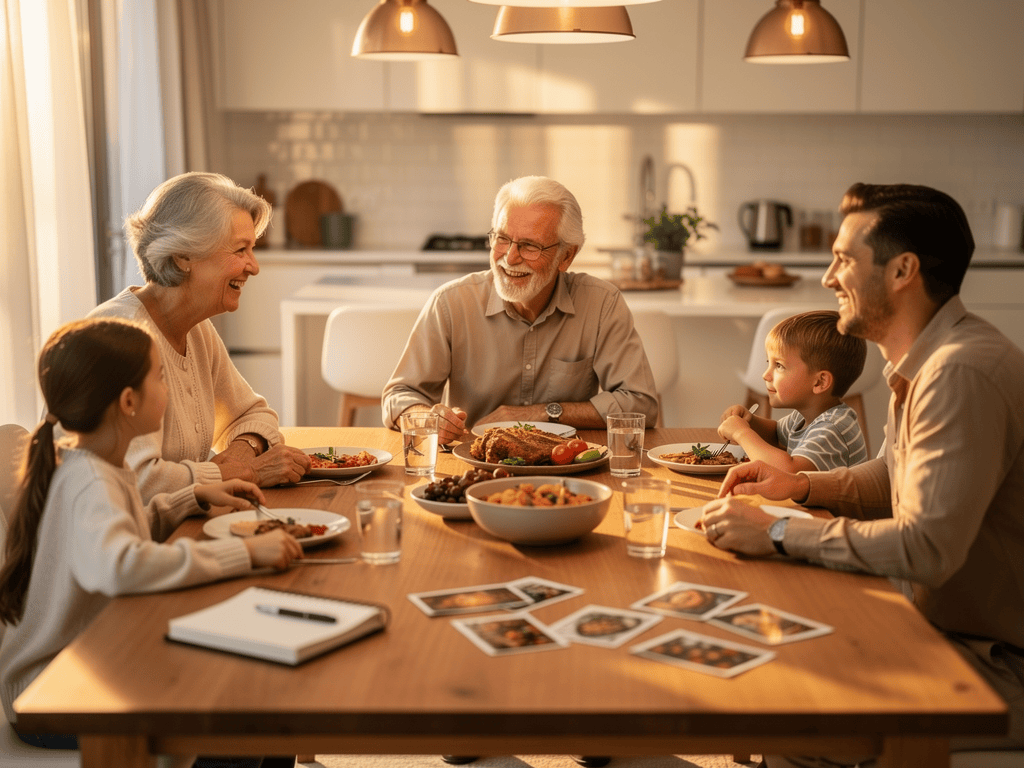
Why shared meals are so important
Shared meals are more than just food intake – they are moments of connection, exchange, and community. For your grandchildren, these moments are particularly valuable because they not only gather culinary experiences but also learn how important it is to spend time together and listen to each other. When you collect memories of these special moments, you give your grandchildren something that will accompany them throughout their lives.
Memories of shared meals help your grandchildren understand their family history and know their roots. When you collect recipes, photos, and stories, you create a connection between generations that will still exist when you are no longer there. Your grandchildren will cherish these memories and can pass them on to their own children, keeping your family traditions alive.
Shared meals are also an opportunity to pass on values and traditions. When you show how important it is to eat together, have time for each other, and listen to each other, you give your grandchildren important lessons they can apply in their own lives. Memories of these moments will help your grandchildren understand what family means and how important it is to be there for each other.
The meaning of shared meals
Shared meals are an important part of family life. They offer the opportunity to exchange ideas, tell stories, and spend time together. For your grandchildren, these moments are particularly valuable because they learn how important it is to take time for each other and listen to each other. When you collect memories of these moments, you give your grandchildren something that will accompany them throughout their lives.
The meaning of shared meals goes beyond eating. It is about community, sharing experiences, and the feeling of belonging. When you show how important it is to eat together and have time for each other, you give your grandchildren important values they can apply in their own lives. Memories of these moments will help your grandchildren understand what family means and how important it is to be there for each other.
Shared meals are also an opportunity to maintain and pass on traditions. When you collect recipes, stories, and memories, you create a connection between generations that will still exist when you are no longer there. Your grandchildren will cherish these memories and can pass them on to their own children, keeping your family traditions alive.
What grandchildren learn from shared meals
Your grandchildren learn much more than just how to eat during shared meals. They learn how important it is to take time for each other, listen to each other, and experience community. These lessons will accompany them throughout their lives and help them build and maintain strong relationships.
Shared meals are also an opportunity to develop culinary skills. When your grandchildren see how you cook, how you use recipes, and how you handle food, they learn important skills they can apply in their own lives. Memories of these moments will help them cook themselves and continue your family traditions.
When you collect memories of shared meals, you also give your grandchildren the opportunity to understand their family history. Recipes, stories, and photos help your grandchildren know their roots and understand where they come from. This connection to family history will help your grandchildren develop their own identity and understand what family means.
Collecting and documenting recipes
Recipes are an important part of family history. When you collect and document recipes, you give your grandchildren not only the opportunity to recreate the dishes you prepared together but also the stories and memories associated with these recipes. A family recipe book is a valuable collection that connects generations and keeps your family traditions alive.
When collecting recipes, you should not only write down the ingredients and preparation steps but also the stories associated with these recipes. Tell where the recipe comes from, who first cooked it, and what special moments are associated with it. These stories make the recipes something special and help your grandchildren understand the meaning of these dishes.
A family recipe book can also be a beautiful shared activity with your grandchildren. Let your grandchildren help collect and write down the recipes, and tell them the stories associated with the recipes. This way, you not only create a valuable collection but also beautiful memories of the time you spent together.
Creating a family recipe book
A family recipe book can be created in various ways. You can use a handwritten book, create a digital document, or a combination of both. It is important that the recipe book is clearly structured and contains all important information: ingredients, preparation steps, portion sizes, and of course the stories associated with the recipes.
When creating a handwritten recipe book, you can embellish it with photos, drawings, or other personal elements. Let your grandchildren help with the design – they can add drawings, paste photos, or make their own notes. This way, the recipe book becomes a personal and valuable keepsake that connects generations.
A digital recipe book has the advantage that it is easy to update and share. You can add photos of the dishes, embed videos of the preparation, and share the recipe book with other family members. It is important to create regular backups so that the valuable memories are not lost.
Writing stories about recipes
Every recipe has a story. When you write down these stories, you make the recipes something special and help your grandchildren understand the meaning of these dishes. Tell where the recipe comes from, who first cooked it, what special occasions are associated with it, and what memories you associate with it.
The stories about recipes can also contain anecdotes: tell about mishaps while cooking, special moments when the dish was served, or people who particularly enjoyed eating this dish. These small details make the recipes come alive and help your grandchildren imagine what it was like when you first cooked the dish.
When writing down stories about recipes, you should also include your grandchildren's memories. Ask them what they particularly like about the dishes, what memories they associate with them, and what they would like to learn. This way, the recipe book becomes a shared project that connects generations and keeps your family traditions alive.
Photos and videos of meals
Photos and videos of shared meals are valuable memories that will accompany your grandchildren throughout their lives. When you capture these moments, you give your grandchildren the opportunity to remember these special times later and share memories of the shared meals. Photos and videos bring the memories to life and help your grandchildren imagine what it was like when you ate together.
When taking photos of meals, you should not only photograph the finished dishes but also the preparation process, the shared time at the table, and the special moments that arise. These photos show not only what was eaten but also how important it is to spend time together and experience community.
Videos can be particularly valuable because they not only show what happened but also capture the sounds, mood, and atmosphere. Short videos of the preparation, the shared meal, or special moments at the table can help your grandchildren remember these times later and share memories of the shared meals.
Photographing meals
When photographing meals, you should make sure that the photos capture the mood and atmosphere. Don't just photograph the finished dishes, but also the preparation process, the shared time at the table, and the special moments that arise. These photos show not only what was eaten but also how important it is to spend time together.
Good photos of meals are created when you pay attention to lighting, present the dishes attractively, and include the people at the table. You don't have to be a professional photographer – even simple photos with a smartphone can be valuable memories. It is important that the photos capture the mood and atmosphere and that they help remember these special moments later.
When taking photos of meals, you should also make sure that the photos are organized and labeled. Note when the photo was taken, who was there, and what was cooked. This way, you can easily assign the memories later and organize the photos in a memory book or digital collection.
Recording short videos
Short videos of shared meals can be particularly valuable because they not only show what happened but also capture the sounds, mood, and atmosphere. Videos of the preparation, the shared meal, or special moments at the table can help your grandchildren remember these times later.
When recording videos, you should make sure that the videos are not too long – short clips of a few minutes are often more valuable than long recordings. Focus on special moments: the preparation of a favorite dish, the shared meal at the table, or conversations and stories that arise.
Videos can also be a beautiful way to document recipes. When you show how a dish is prepared, your grandchildren can watch the video later and recreate the recipe. Combine the video with the written recipe and the stories associated with it to create comprehensive documentation.
Collecting stories and anecdotes
Stories and anecdotes of shared meals are valuable memories that will accompany your grandchildren throughout their lives. When you collect and write down these stories, you give your grandchildren the opportunity to remember these special moments later and share memories of the shared meals. Stories bring the memories to life and help your grandchildren imagine what it was like when you ate together.
The stories can be about special occasions, mishaps while cooking, people who particularly enjoyed certain dishes, or traditions associated with certain meals. These stories show not only what was eaten but also how important it is to spend time together and experience community.
When collecting stories, you should also include your grandchildren's memories. Ask them what they particularly enjoyed about the shared meals, what memories they associate with them, and what stories they would like to tell. This way, the collection of stories becomes a shared project that connects generations.
Recording oral stories
Oral stories can be particularly valuable because they capture the voice, emphasis, and emotions. When you record stories, you can listen to the recordings later and write down the stories or use the recordings directly in a memory book or digital collection.
When recording stories, you should make sure that the recording quality is good and that the stories are clearly understandable. You can use a smartphone, a recording device, or a video camera. It is important that the recordings are organized and labeled so that you can easily assign the memories later.
Oral stories can also be a beautiful way to interact with your grandchildren. Let your grandchildren tell stories, ask questions, or share their own memories. This way, the recording becomes a shared project that connects generations and keeps memories of shared meals alive.
Writing down stories
When writing down stories, you should make sure that the stories are lively and vivid. Don't just describe what happened, but also how it was, who was there, and what feelings and emotions were associated with it. These details bring the stories to life and help your grandchildren imagine what it was like when you ate together.
The stories should also convey the meaning of shared meals. Tell why these moments were important, what values and traditions are associated with them, and how these memories will accompany your grandchildren. This way, you help your grandchildren understand the meaning of shared meals.
When writing down stories, you should also make sure that the stories are organized and categorized. You can organize the stories by occasions, dishes, or people. This way, you can easily find the memories later and use the stories in a memory book or digital collection.
Creating a memory book
A memory book is a valuable collection of recipes, photos, stories, and other memories of shared meals. When you create a memory book, you give your grandchildren something that will accompany them throughout their lives and that they can pass on to their own children. A memory book connects generations and keeps your family traditions alive.
A memory book can be created in various ways: as a handwritten book, as a digital document, or as a combination of both. It is important that the book is clearly structured and contains all important memories: recipes, photos, stories, and other personal elements that document the shared meals.
When creating a memory book, you should also involve your grandchildren. Let them help with the design, tell stories, or add their own memories. This way, the memory book becomes a shared project that connects generations and keeps memories of shared meals alive.
Structure and organization
A memory book should be clearly structured so that your grandchildren can easily find the memories later. You can organize the book by occasions, dishes, seasons, or other categories. It is important that the structure is logical and that all important memories are included.
Each section of the memory book should contain recipes, photos, stories, and other personal elements. You can also leave space for notes, drawings, or other personal additions. This way, the memory book becomes a living document that connects generations and preserves memories of shared meals.
When creating a digital memory book, you can also add interactive elements: videos, audio recordings, links to recipes or other resources. These elements bring the memory book to life and help your grandchildren remember these special moments later.
Compiling content
When compiling content for a memory book, you should make sure that all important memories are included: recipes, photos, stories, and other personal elements. You can also leave space for notes, drawings, or other personal additions that can be added later.
The content should also convey the meaning of shared meals. Tell why these moments were important, what values and traditions are associated with them, and how these memories will accompany your grandchildren. This way, you help your grandchildren understand the meaning of shared meals.
When compiling content, you should also involve your grandchildren. Let them help with the design, tell stories, or add their own memories. This way, the memory book becomes a shared project that connects generations and keeps memories of shared meals alive.
Organizing digital memories
Digital memories have the advantage that they are easy to organize, share, and secure. When you collect digital memories, you can organize photos, videos, recipes, and stories in a clear structure and create regular backups so that the valuable memories are not lost.
When organizing digital memories, you should make sure that the files are well named and categorized. Use meaningful file names that describe the date, occasion, and content. This way, you can easily find the memories later and organize the files in a digital collection.
Digital memories can also be easily shared. You can share the collection with other family members so they can also enjoy the memories. It is important to create regular backups so that the valuable memories are not lost if a device breaks or is lost.
Creating digital collections
When creating a digital collection, you should make sure that the structure is clear and that all important memories are included. You can organize folders by occasions, dishes, seasons, or other categories. It is important that the structure is logical and that all important memories are easy to find.
Digital collections can also contain interactive elements: videos, audio recordings, links to recipes or other resources. These elements bring the collection to life and help your grandchildren remember these special moments later. You can also add notes, drawings, or other personal additions.
When creating a digital collection, you should also make sure that the files are well named and categorized. Use meaningful file names that describe the date, occasion, and content. This way, you can easily find the memories later and organize the files.
Creating backups
Backups are important so that valuable memories are not lost if a device breaks or is lost. When collecting digital memories, you should create regular backups and store them in different places: on an external hard drive, in the cloud, or on other devices.
When creating backups, you should make sure that the backups are current and that all important memories are included. You can also store multiple backups in different places to ensure that the memories are still available if a backup is lost or damaged.
Backups can also be a good way to share memories with other family members. You can copy the backups to USB sticks or other storage media and pass them on to other family members. This way, they can also enjoy the memories and expand the collection.
Sharing memories with grandchildren
When you collect memories of shared meals, you should also share them with your grandchildren. Show them the recipes, photos, and stories, and tell them why these moments were important and what meaning they have. This way, you help your grandchildren understand the meaning of shared meals and appreciate the memories.
Sharing memories can also be a beautiful shared activity. Let your grandchildren help browse through the memory book, tell stories, or add their own memories. This way, the memory book becomes a living document that connects generations and preserves memories of shared meals.
When you share memories with your grandchildren, you also give them the opportunity to continue your family traditions. Show them how important it is to eat together, have time for each other, and listen to each other. These values will accompany your grandchildren throughout their lives and help them build and maintain strong relationships.
Different Types of Memories
Methods for Organizing Memories
Backup Strategies for Digital Memories
Tips for Collecting Recipes
- Write down not only ingredients but also the stories behind them
- Photograph the finished dishes for the recipe book
- Let grandchildren help write them down and make their own notes
- Organize recipes by occasions, seasons, or categories
- Create regular backups of digital recipes
- Share recipes with other family members
Tips for Photographing Meals
- Photograph not only the dishes but also the process
- Include the people at the table in the photos
- Pay attention to good lighting for appealing photos
- Label photos with date, occasion, and people
- Organize photos in digital folders or albums
- Create regular backups of valuable photos
Tips for Collecting Stories
- Tell not only what happened but also how it was
- Include your grandchildren's memories in the stories
- Record oral stories for later transcription
- Organize stories by occasions or dishes
- Combine stories with recipes and photos
- Let grandchildren add their own stories