



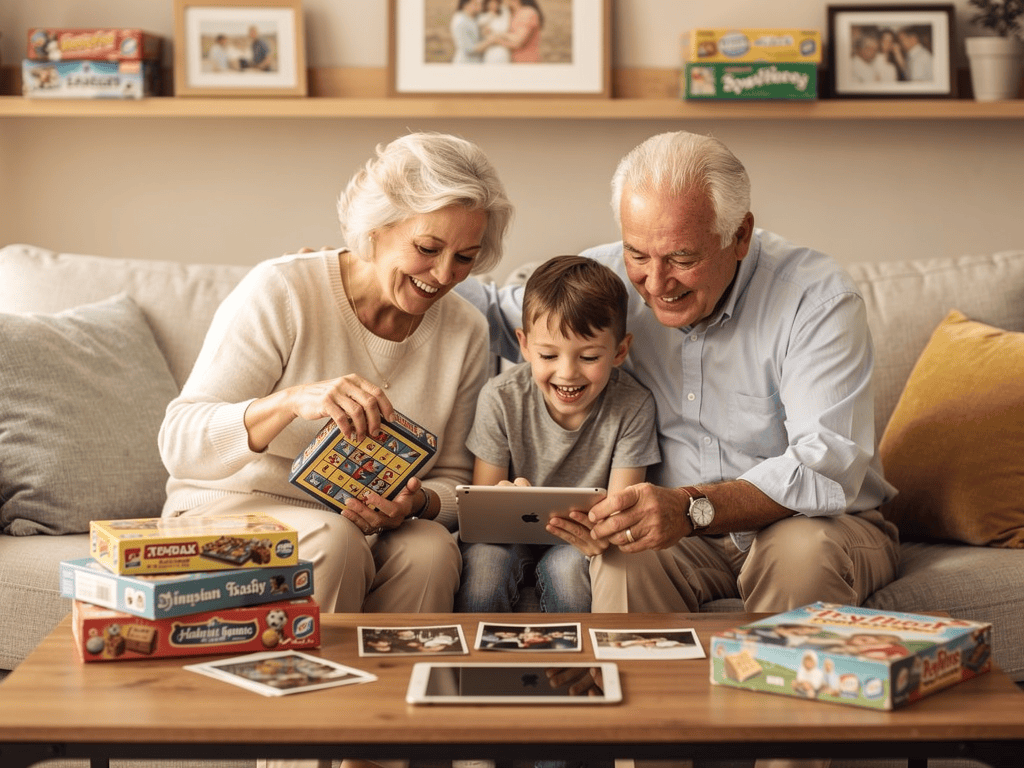
Why memories of shared games are important
Shared games between grandparents and grandchildren create special moments of connection and joy. These moments are not only valuable for the moment, but become precious memories that will accompany your grandchildren throughout their lives. When you collect and preserve these memories, you give your grandchildren something invaluable: the opportunity to look back on these special times later and feel the connection to you, even when you are no longer there.
Memories of shared games help your grandchildren understand their own history and feel their roots. When your grandchildren later see photos, stories, or videos of shared play moments, they remember not only the games themselves, but also the feelings associated with them: the joy, the laughter, the feeling of security and the special connection to you. These memories strengthen the relationship between you and your grandchildren and help them develop their identity.
As grandparents, you have the opportunity to actively collect and preserve these memories. You can ensure that your grandchildren later have access to these precious moments and that these memories are not lost. By collecting memories, you are doing something for your grandchildren: you give them the opportunity to know their own history and share the special moments with you, even as time passes.
The significance of shared play moments
Shared games are more than just pastimes – they are moments of connection, learning, and joy. When you play with your grandchildren, you create a special atmosphere in which your grandchildren feel safe and loved. These moments shape your grandchildren sustainably and help them develop positive memories of their childhood.
Games also offer the opportunity to convey values, develop skills, and strengthen relationships. When you collect memories of these games, you document not only the games themselves, but also the lessons learned and the feelings shared. These memories become a treasure for your grandchildren, showing them how important they were to you and how much time and attention you gave them.
The significance of these moments becomes particularly clear when your grandchildren grow older. When they later look back on these memories, they recognize how much you did for them and how much you cared for them. This realization strengthens their connection to you and helps them understand their own role as grandparents or parents when they themselves are in this position.
Long-term impact on grandchildren
Memories of shared games have a long-term positive impact on your grandchildren. Studies show that children who have positive memories of their grandparents develop stronger self-esteem and can better cope with challenges. These memories give your grandchildren a sense of belonging and help them develop their identity.
When your grandchildren later look back on these memories, they remember not only the games, but also the values you conveyed to them: patience, fairness, creativity, and the joy of doing things together. These values shape your grandchildren sustainably and help them become responsible and happy adults.
Memories of shared games also help your grandchildren understand their own family history. When they later see photos or stories of shared play moments, they recognize how important family is and how valuable the time with grandparents was. This realization strengthens their connection to the family and helps them nurture their own relationships.
Different methods for collecting memories
There are many different ways to collect and preserve memories of shared games. Each method has its own advantages and can be used in different ways. It is important that you choose a method that suits you and your grandchildren and that brings you joy. If you enjoy collecting, you will also stick with it long-term and regularly add new memories.
You can also combine different methods to create a comprehensive collection. Perhaps you want to collect photos for visual memories, write stories for emotional moments, and record videos for moving moments. By combining different methods, you create a rich collection that covers all aspects of your shared play moments.
It is important that you start collecting, even if it is initially only small steps. You do not have to do everything perfectly – what matters is that you start and regularly add new memories. Over time, you will build a wonderful collection that your grandchildren will later appreciate.
Photo albums and image collections
Photo albums are a classic and proven method for collecting memories of shared games. You can collect photos of shared play moments, paste them into an album, and add short descriptions. Photo albums have the advantage that they are tangible and that your grandchildren can later flip through them to remember the shared moments.
When creating photo albums, you can choose different approaches. You can create an album for each year, an album for certain games, or an album for special occasions. It is important that you label the photos with date and short descriptions so that your grandchildren later know when and what happened. You can also add small notes that describe the mood or special moments.
Modern photo albums also offer the possibility to print digital photos and paste them into an album. You can have photos from your smartphone or tablet printed and then insert them into an album. This way, you can combine the advantages of digital photography with the tangibility of an album. Your grandchildren will later appreciate holding these physical memories in their hands.
Storybooks and diaries
Storybooks and diaries are a wonderful way to document the emotional aspects of shared games. You can write down which games you played, how your grandchildren reacted, what special moments there were, and what lessons were learned. These written memories give your grandchildren later insight into the thoughts and feelings associated with the shared play moments.
If you keep a storybook or diary, you do not have to write every day – what matters is that you regularly capture the special moments. You can make a short note after each play visit or write a longer entry once a week. It is important that you write authentically and describe the moments as you experienced them. Your grandchildren will later appreciate these personal stories.
You can also involve your grandchildren in the writing. Let them write down or draw their own thoughts and feelings about the games. This creates a shared memory book that shows the perspectives of both generations. This shared documentation strengthens the relationship between you and your grandchildren and creates a unique memory collection.
Digital collections and videos
Digital collections and videos are a modern and practical method for collecting memories of shared games. You can store and organize photos and videos on your smartphone, tablet, or computer. Digital collections have the advantage that they are easy to share and that you can store many memories in a small space.
When creating digital collections, you can use different folder structures. You can organize folders by years, by games, or by special occasions. It is important that you name the files meaningfully and add date and description. This way, you can easily find the desired memories later.
Videos are particularly valuable because they capture not only the visual aspects, but also the sounds, voices, and movements of the shared play moments. You can record short videos of special play moments and share them with your grandchildren later. These videos will become a treasure for your grandchildren, showing them how the shared moments really were.
Practical tips for collecting
Collecting memories of shared games should not be a burden, but a joy. It is important that you choose an approach that suits you and that you enjoy. If you feel overwhelmed, start with small steps and slowly build your collection. It is better to regularly collect small memories than to create a large collection once a year.
It is also important that you have realistic expectations. You do not have to document every play moment – what matters are the special moments, the milestones, and the moments that are particularly close to your and your grandchildren's hearts. If you try to document everything, collecting can become a burden. Focus on the moments that are really important.
Collecting memories should also be a shared activity that brings joy to you and your grandchildren. Involve your grandchildren in the process and let them help decide which moments should be documented. This way, collecting becomes a shared experience that strengthens the relationship between you and your grandchildren.
Regularity and continuity
Regularity is important when you want to collect memories. It is better to regularly collect small memories than to create a large collection once a year. If you create a routine – for example, making a short note after each play visit or sorting photos once a week – collecting becomes a habit and is easier for you.
You can also schedule fixed times for collecting. Perhaps you want to take an hour every Sunday evening to document the memories of the week. Or you make it a shared activity with your grandchildren, where you go through the memories together and add new ones. This way, collecting becomes a fixed part of your shared time.
It is important that you are not perfectionistic. It is better to collect irregularly than not to collect at all. If you once do not have time or have forgotten to document a memory, that is not bad. What matters is that you continue and regularly add new memories. Over time, you will build a wonderful collection.
Involving grandchildren in the process
Your grandchildren should be actively involved in the collecting process. Let them help decide which moments should be documented, which photos should go into the album, and which stories should be written down. This way, collecting becomes a shared activity that strengthens the relationship between you and your grandchildren.
You can also let your grandchildren collect memories themselves. Give them a camera or smartphone and let them take their own photos of the shared play moments. Or let them write down or draw their own thoughts and feelings about the games. This creates a collection that shows the perspectives of both generations.
When you involve your grandchildren, they also learn how important memories are and how to preserve them. This lesson will help them later when they want to collect memories themselves. By showing them how to collect and preserve memories, you give them a valuable tool that they can use throughout their lives.
Documenting special play moments
There are certain play moments that are particularly important and that you should definitely document. These special moments are milestones in the development of your grandchildren and in your shared relationship. When you capture these moments, you create a valuable documentation that your grandchildren will later appreciate.
Special play moments can be various things: the first time your grandchild understood a certain game, a particularly creative game you developed together, or a moment when your grandchild learned an important lesson. These moments are not only important for the moment, but become memories that will accompany your grandchildren throughout their lives.
When documenting special play moments, you should not only capture the game itself, but also the context: the mood, the feelings, the lessons learned, and the significance of the moment. This additional information makes the memories richer and gives your grandchildren a more complete picture of the shared moments later.
First times and milestones
First times are special moments that you should definitely document. The first time your grandchild understood a certain game, the first time you played a complex game together, or the first time your grandchild understood an important rule – these moments are milestones in the development of your grandchildren and should be captured.
When documenting first times, you can take photos, write a short story, or record a video. It is important that you capture the moment as it was, with all the details that made it special. Your grandchildren will later appreciate these documentations and be able to remember these special moments.
Milestones can also be progress in the development of your grandchildren. When your grandchild understood a complex strategy for the first time, when they played fairly for the first time, or when they creatively changed a game for the first time – these moments show the growth of your grandchildren and should be documented.
Favorite games and traditions
Favorite games are games that you and your grandchildren particularly enjoy playing and that have become a tradition. These games are particularly important because they shape the relationship between you and your grandchildren and become a fixed part of your shared time. When you document these favorite games, you create a memory of the special traditions you developed together.
When documenting favorite games, you can capture not only the game itself, but also the story behind it: how the game became a favorite, what variations you developed, and what special moments are associated with it. These stories make the memories richer and show how the relationship between you and your grandchildren has developed.
Traditions emerge when certain games or activities are regularly repeated. When you document these traditions, you create a memory of the continuity of your relationship and the special rituals you developed together. These traditions will become an important part of your grandchildren's childhood memories.
Creatively designing memories
Memories do not only have to be collected – they can also be creatively designed. When you creatively design memories, you make them something special that your grandchildren will later appreciate. Creative design can take various forms: from handmade photo albums to illustrated storybooks to digital collages.
When you creatively design memories, you can bring in your own skills and interests. If you enjoy crafting, you can create handmade albums or collages. If you enjoy writing, you can write detailed stories about the shared play moments. If you enjoy photography, you can take artistic photos of the play moments.
Creative design also makes collecting memories a joy. If you enjoy creatively designing memories, you will also stick with it long-term and regularly add new memories. Your grandchildren will later appreciate holding these creative memories in their hands and seeing the effort you put in.
Craft projects with memories
Craft projects are a wonderful way to creatively design memories. You can create handmade photo albums, make collages from photos and mementos, or fill boxes with memories. These handmade projects are not only beautiful to look at, but also personal and unique.
When you do craft projects with memories, you can also involve your grandchildren. Let them help with crafting, bring in their own ideas, or add their own mementos. This way, crafting becomes a shared activity that strengthens the relationship between you and your grandchildren while creating beautiful memories.
Craft projects can also be made for special occasions. Perhaps you want to create a special memory album for your grandchild's birthday or a collage with memories of the shared games of the year for Christmas. These special projects will become valuable gifts for your grandchildren that they will keep throughout their lives.
Creating shared memory books
Memory books are a special form of documentation that you can create together with your grandchildren. You can make a book about the shared games, with photos, stories, drawings, and mementos. These books will become a treasure for your grandchildren that they can later flip through to remember the shared moments.
When creating a memory book, you can choose different approaches. You can create a book for each year, a book for certain games, or a book for special occasions. It is important that you design the book together with your grandchildren and that both generations can bring in their perspectives.
Memory books can also be created digitally. You can create a digital book with photos, texts, and videos and then have it printed or save it as a PDF. This way, you can combine the advantages of digital design with the tangibility of a book. Your grandchildren will later appreciate holding this book in their hands or flipping through it digitally.
Sharing and passing on memories
Memories are not only for you and your grandchildren – they can also be shared with the whole family. When you share memories, you give other family members the opportunity to participate in the shared play moments and understand the relationship between you and your grandchildren. Sharing memories also strengthens the connection within the family.
You can share memories in various ways. You can share photos or stories in family chats, show memory albums at family celebrations, or share digital collections with other family members. It is important that you share the memories in a way that makes them accessible and understandable to others.
Sharing memories can also be a way to strengthen the relationship between different generations. When other family members see the memories, they better understand how important the time with grandparents is for the grandchildren and how valuable these shared moments are. This realization can help bring the family closer together.
Sharing memories with the family
When you share memories with the family, you can use various methods. You can share photos or stories in family chats, show memory albums at family celebrations, or share digital collections with other family members. It is important that you share the memories in a way that makes them accessible and understandable to others.
Family celebrations are a good opportunity to share memories. You can bring memory albums or books and show them at the celebration. This way, all family members can see the shared play moments and remember them. These shared moments strengthen the connection within the family and create positive memories for everyone.
You can also introduce regular "memory rounds" where you go through the memories of the last weeks or months together with the family. These rounds can become a beautiful tradition that regularly brings the family together and keeps the shared memories alive.
Digital sharing with grandchildren
Digital memories can easily be passed on to your grandchildren, even when they grow older or move to other cities. You can share digital photo albums, videos, or stories via email, cloud services, or special apps. This way, your grandchildren can access the memories at any time, even when they no longer live near you.
When you pass on digital memories, you should ensure that the files are well organized and named. Use meaningful file names and organize the files in logical folders. This way, your grandchildren can later easily find and access the desired memories.
You can also regularly pass on new memories to your grandchildren. Perhaps you want to send a compilation of the latest memories once a month or share a special collection on special occasions. This way, your grandchildren stay connected to the shared memories even across the distance.
Long-term preservation of memories
The long-term preservation of memories is important so that your grandchildren can later still have access to these precious moments. If you want to preserve memories long-term, you should combine different methods and ensure that the memories are stored in different places. This way, the memories are not lost, even if one method no longer works.
For physical memories such as photo albums or books, you should ensure that they are stored in a safe place protected from moisture, light, and pests. You can also create copies or digitize the memories to ensure they are not lost. For digital memories, you should regularly create backups and store the files in different places.
It is also important that you let your grandchildren know where the memories are stored and how they can access them. When you organize and document the memories, your grandchildren can later easily access and use them. By preserving the memories long-term, you give your grandchildren something invaluable: the opportunity to look back on these special moments even later.
Comparison of different methods for collecting memories
Tips for documenting special play moments
Methods for long-term preservation of memories
Practical tips for regularly collecting memories
- Make a short note after each play visit
- Sort and label photos once a week
- Create a monthly compilation of the best moments
- Create an annual memory album or book
- Regularly involve grandchildren in the collecting process
- Schedule fixed times for collecting
Creative ideas for designing memories
- Handmade photo albums with personal notes
- Illustrated storybooks with grandchildren's drawings
- Digital collages with photos and texts
- Memory boxes with small objects
- Shared memory books with both generations
- Video collages with the best play moments
Special play moments that should be documented
- The first time a certain game was understood
- Particularly creative game variations
- Moments when important lessons were learned
- Favorite games that have become traditions
- Special achievements and breakthroughs
- Moments of special connection and joy