



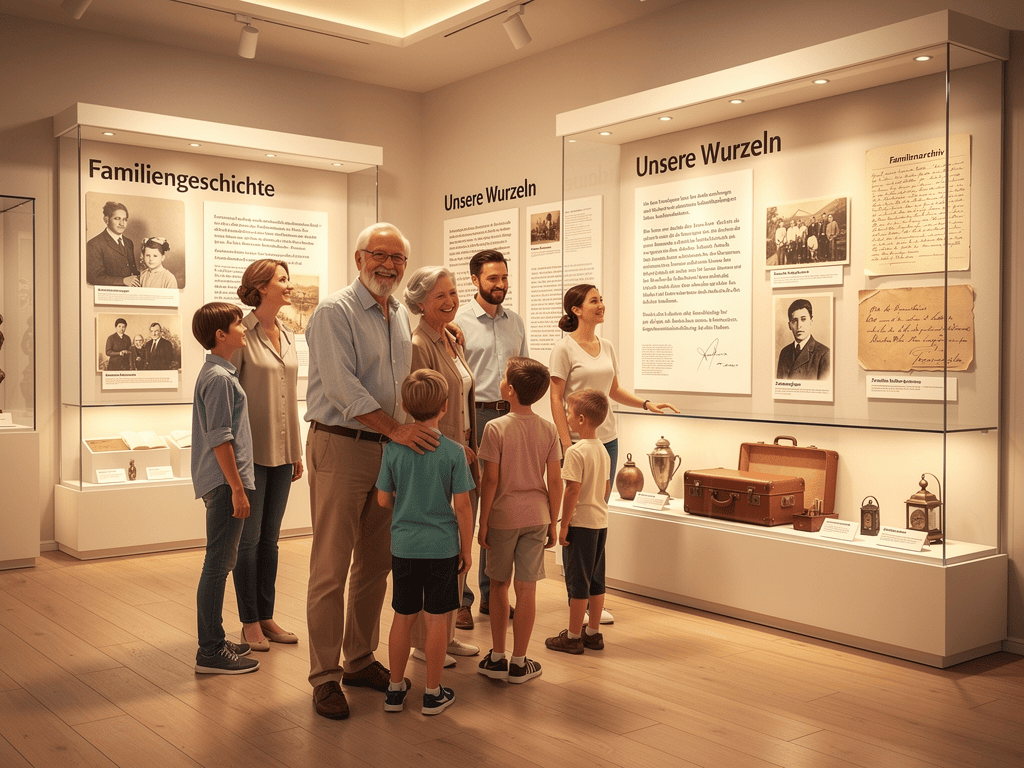
Why exhibit family history in a museum?
Exhibiting your family history in a museum is a special way to preserve your memories and traditions for your grandchildren. While photos and stories at home often disappear into drawers or albums, in a museum they receive a public stage and become part of a larger cultural context. For your grandchildren, this means their family history is not only private but recognized as valuable cultural heritage.
When you exhibit your family history in a museum, you create something lasting for your grandchildren. The exhibition is documented, photographed, and often recorded in catalogs or digital archives. Your grandchildren can return later and see how their family was part of the history of their region or country. This experience shapes them and gives them a sense of pride and connection to their origins.
A museum also offers the opportunity to place your family history in a larger historical context. Your personal memories become part of a larger narrative about a time, a place, or a community. For your grandchildren, this means they not only learn about their own family history but also understand how it is embedded in the history of their surroundings. This connection between personal and public history is something special that you can give to your grandchildren.
Significance for grandchildren
For your grandchildren, a museum exhibition of their family history is a unique experience. They see that their family and their history are important enough to be presented publicly. This strengthens their self-confidence and sense of identity. When they later visit the museum with friends or classmates, they can proudly show: "This is my family, this is our history."
A museum exhibition makes history tangible and alive. While history books often seem abstract and distant, your grandchildren see concrete objects, photos, and stories from their own family in the exhibition. This connection between personal experience and historical context helps them understand and appreciate history better. They learn that history is not just something in books but something that has to do with their own family.
The exhibition can also be an occasion to talk about the past together with your grandchildren. When you prepare and visit the exhibition together, conversations arise about your childhood, your parents and grandparents, traditions and values. These conversations are valuable for your grandchildren because they help them understand their roots and develop a sense of continuity and connection.
Preservation for the future
Museums specialize in preserving objects and stories for the future. When you exhibit your family history in a museum, you ensure it is professionally documented, conserved, and archived. Your grandchildren can be sure that their family history will still be accessible many years from now, even if you are no longer there to tell it.
Museums have the expertise and resources to preserve objects and documents long-term. They use special conservation techniques, climate-controlled rooms, and digital archiving systems. When you entrust your family history to a museum, you place it in professional hands that ensure it remains preserved for future generations.
A museum exhibition also creates official documentation of your family history. The exhibition is photographed, cataloged, and often scientifically documented. This documentation remains even if the exhibition itself ends someday. Your grandchildren and their children can later still access this documentation and trace the history of their family.
Preparing the exhibition
Preparing a museum exhibition is a process that requires time and care, but it is also a wonderful opportunity to explore your family history together with your grandchildren. Start by collecting all the materials you have: photos, letters, documents, objects, mementos. Sort them by themes, time periods, or people. This structuring helps you later develop a coherent exhibition concept.
It is important that you not only collect objects but also document the stories behind them. Every photo, every document, every object has a story. Write down these stories, tell them to your grandchildren, and let them write them down or record them. These stories are just as important as the objects themselves because they give them meaning and context. For your grandchildren, these stories are particularly valuable because they help bring the past to life.
If you have old photos or documents, you should digitize them before handing them over to a museum. Scan photos in high resolution, photograph objects from different angles, and create digital copies of all documents. You can keep these digital copies even if the originals are exhibited in the museum. For your grandchildren, this means they also have access to these materials at home and can view them anytime.
Collecting and sorting materials
Start with an inventory of all materials you have. Search drawers, cabinets, attics, and basements for photos, letters, documents, certificates, newspaper clippings, postcards, and other mementos. Also ask other family members if they have materials they would like to provide for the exhibition. The more materials you collect, the richer your exhibition will be.
Sort the materials by various criteria: chronologically by time periods, thematically by topics (e.g., profession, family, travel), or by people. This sorting helps you bring structure to your collection and develop a coherent exhibition concept. Note for each object what it is, when it was created, who owned it, and what story is associated with it.
Also pay attention to the condition of the materials. Damaged photos or documents should be handled carefully and possibly restored before handing them over to a museum. If you are unsure how to handle certain materials, you can contact the museum, which often has experts for conservation and restoration.
Documenting stories
Every object in your collection has a story, and these stories are just as important as the objects themselves. Take time to write down or record these stories. Tell the stories to your grandchildren and let them write them down or record them. This joint work makes the preparation a special experience for you and your grandchildren.
When writing stories, make sure to capture all important details: Who was involved? When did it happen? Where did it happen? What happened? Why was it important? These details help later in designing the exhibition and conveying the meaning of the objects to visitors. For your grandchildren, these details are particularly valuable because they help them understand the past.
Also tell stories that are not directly related to the objects but are part of your family history. Anecdotes, memories, traditions – all of this belongs to your family history and can flow into the exhibition. These stories make the exhibition alive and show that history consists not only of objects but also of people and their experiences.
Digitizing photos and documents
Before handing materials over to a museum, you should digitize them so that you and your grandchildren also have access to them at home. Scan photos in high resolution (at least 300 dpi) so they are also suitable for larger prints. Photograph objects from different angles and in good lighting so all details are visible.
Create digital copies of all documents, letters, and certificates. You can organize these copies in folders on your computer or in cloud storage. Label the files with meaningful names that indicate what is shown and when it was created. This organization helps you later find and use the materials.
You can also use the digital copies to create a digital presentation or digital album that you can show your grandchildren. This way they can explore the family history at home even if the originals are exhibited in the museum. These digital materials are also a good backup copy in case something happens to the originals.
Finding the right museum
Not every museum is suitable for every type of exhibition. You should find a museum that thematically fits your family history. Is there a local history museum, city museum, or specialized museum in your region that deals with the time or topic that your family history concerns? A museum that deals with local history is often a good choice because it has an interest in stories from the region.
Contact several museums and ask if they are interested in an exhibition of your family history. Many museums are open to such projects, especially if they have a local or regional connection. Explain what you want to exhibit, what story you want to tell, and why it is relevant to the region or the museum's theme. The better you can convince the museum of the importance of your family history, the greater the chance it will show interest.
Also consider the size and resources of the museum. A small local history museum may have more time and flexibility for a personal project, while a larger museum has more resources for professional presentation and marketing. Consider what is more important to you: personal care or professional presentation. Both have their advantages, and the right choice depends on your priorities.
Researching local museums
Start by researching museums in your region. Is there a local history museum, city museum, regional museum, or specialized museum that fits your family history? Look at the museums' websites to see what topics they cover and what exhibitions they have already shown. This gives you an impression of whether your project fits the museum.
Also visit the museums in person if possible. This way you can get an impression of the atmosphere, presentation, and audience. Talk to the staff and ask if they might be interested in an exhibition of your family history. Personal contacts are often helpful in getting a project rolling.
Also ask in your community or city if there are local initiatives or associations that deal with local history. These organizations often have good contacts with museums and can help you make connections. Historical associations or history societies can also be good contacts.
Checking thematic fit
A museum that deals with local history is often a good choice for an exhibition of your family history, especially if your family has lived in the region for a long time. A local history museum is interested in stories from the region and can place your family history in a larger local context. This makes the exhibition interesting not only for you and your grandchildren but also for other visitors.
If your family history has a particular professional or thematic focus – for example, agriculture, crafts, industry, or migration – a specialized museum might also be interested. An industrial museum might be interested in your family's history if your ancestors worked in industry. A migration museum might be interested if your family immigrated from another country.
Also consider what story you want to tell. Is it about your family's history over several generations? About a specific time or event? About a specific profession or tradition? The clearer you can define your story, the easier it will be to find the right museum.
Contacting museums
When you have found a museum that fits your family history, make contact. Write an email or letter introducing yourself, briefly describing your family history, and explaining why you think it might be interesting for the museum. Include some photos or documents to give the museum a first impression.
Be patient when waiting for a response. Museums receive many inquiries and often have limited resources. If you have not received a response after some time, you can politely follow up. Sometimes it also helps to visit in person or call to establish initial contact.
If the museum shows interest, arrange an appointment for a meeting. Prepare to bring your materials and tell your story. Be open to suggestions from the museum on how the exhibition could be designed. Museums often have experience with exhibitions and can provide valuable tips.
Developing an exhibition concept
A good exhibition concept is the foundation for a successful exhibition. Think together with the museum about what story you want to tell and what focus you want to set. Is it about your family's history over several generations? About a specific time or event? About a specific profession or tradition? The clearer you define your story, the better the exhibition can be designed.
Develop a structure for the exhibition. Should it be built chronologically, from the oldest generations to the present? Or thematically, with different areas for different aspects of your family history? Or biographically, with a focus on specific people? The structure should be logical and help visitors understand and follow the story.
Also consider which objects, photos, and documents you want to exhibit. Not everything you have collected needs to be in the exhibition. Choose the most meaningful and interesting pieces that best tell your story. Less is often more – a well-curated exhibition with selected objects is often more effective than an overloaded exhibition with too many objects.
Defining themes and focus
Think about what themes and focus you want to set in your exhibition. Is it about your family's history over several generations? About a specific time or event? About a specific profession or tradition? The clearer you define your themes, the better the exhibition can be designed.
Also consider what might be interesting for visitors. While your family history is personally important to you and your grandchildren, it should also be interesting for other visitors. Consider which aspects of your story have a larger historical or cultural context and could be relevant to a broader audience.
Work together with the museum on theme selection. Museums have experience with what themes are interesting for visitors and how to present them best. Let yourself be advised by the experts at the museum, but also keep your own priorities in mind. The exhibition should tell your story but also be accessible and interesting for visitors.
Chronology and structure
A chronological structure is often a good choice for a family history because it helps visitors follow the development of your family over time. Start with the oldest generations and work your way to the present. This way visitors can see how your family has developed and what changes have occurred.
Alternatively, you can also choose a thematic structure with different areas for different aspects of your family history. For example, an area for professions, an area for traditions, an area for travel or migration. This structure can be interesting if you want to particularly highlight various aspects of your family history.
A biographical structure with a focus on specific people can also be interesting, especially if there are particularly formative personalities in your family. Each person can get their own area where their story, their objects, and their significance for the family are presented. This structure can be particularly interesting for your grandchildren because it helps them get to know individual people better.
Planning interactive elements
Interactive elements can make an exhibition more lively and interesting, especially for younger visitors like your grandchildren. Consider what interactive elements you could incorporate: for example, stations where visitors can touch old objects, audio stations with narratives, or digital stations with photos and videos.
Audio stations with narratives of your family history can be particularly effective. Your grandchildren can hear your voice while visiting the exhibition and thus establish a personal connection to the objects and stories. These audio stations can also be interesting for other visitors because they make the exhibition more lively.
Digital stations with photos, videos, or interactive elements can also be interesting. For example, you can show a digital family tree that visitors can click on to learn more about individual people. Or you can show videos in which you or other family members tell stories. These digital elements make the exhibition modern and attractive for younger visitors.
Practical implementation
The practical implementation of a museum exhibition requires careful planning and cooperation with the museum. The museum will help you with design, presentation, and technical implementation. However, you should also bring your own ideas and visions so that the exhibition truly tells your story.
It is important that you also involve your grandchildren in the implementation. Let them participate in selecting objects, contribute to designing texts, or help create interactive elements. This participation makes the exhibition a joint project and gives your grandchildren the feeling of being part of it.
Also plan enough time for implementation. A museum exhibition needs time for planning, design, setup, and opening. Expect several months from initial planning to opening. Use this time to carefully prepare everything and ensure that the exhibition truly tells your story.
Exhibition design and presentation
The exhibition design should support your story and not distract from it. Think together with the museum about which colors, materials, and styles fit your story. Should the design be rather traditional and classic, or modern and contemporary? The choice depends on your story and your audience.
Make sure the objects are well visible and well lit. Display cases should be placed so visitors can view the objects from different angles. Labels should be easily readable and not too small or too far from the objects. The presentation should be professional but also inviting and accessible.
Also consider the needs of different visitor groups. Older visitors may need larger font sizes, younger visitors may need lower display cases or interactive elements. Accessibility is important so all visitors can enjoy the exhibition. Talk to the museum about these aspects and ensure the exhibition is accessible to everyone.
Texts and labels
Good texts and labels are important for a successful exhibition. They should be informative but not too long or complicated. Visitors should be able to quickly understand what they are seeing and why it is important. Write the texts so they are understandable for a broad audience but also interesting for your grandchildren.
Each object should have a label that explains what it is, when it was created, who owned it, and what story is associated with it. These labels should be short and concise but contain all important information. If there is a special story to an object, you can also include it in the label.
Also consider whether you want longer texts for certain areas of the exhibition. These texts can provide more context and help better understand the story. However, they should not be too long so visitors are not overwhelmed. A good balance between information and readability is important.
Incorporating multimedia elements
Multimedia elements such as photos, videos, or audio recordings can make an exhibition more lively and interesting. Consider what multimedia elements you could incorporate: for example, a slideshow with old photos, videos with narratives, or audio stations with stories. These elements make the exhibition appealing to various senses and can be particularly interesting for younger visitors.
If you use videos or audio recordings, make sure they are of good quality and well audible or visible. The technology should work reliably so visitors can actually use the multimedia elements. Talk to the museum about technical possibilities and ensure everything is professionally implemented.
Multimedia elements can also be a good way to tell stories that cannot be represented by objects. For example, you can show videos in which you or other family members tell stories, or audio recordings with memories. These elements make the exhibition more personal and give visitors insight into the people behind the objects.
Involving grandchildren
Preparing and conducting a museum exhibition is a wonderful opportunity to involve your grandchildren in your family history. Let them help collect materials, participate in selecting objects, contribute to designing texts, or help create interactive elements. This participation makes the exhibition a joint project and gives your grandchildren the feeling of being part of it.
When your grandchildren help with preparation, they not only learn about your family history but also how to plan and design an exhibition. This experience is valuable for them and can spark their interest in history and culture. They also learn practical skills such as research, organization, and presentation that can be useful to them later.
The joint work on the exhibition also strengthens the relationship between you and your grandchildren. You spend time together, learn from each other, and create something together. These shared experiences are valuable for your grandchildren and shape them sustainably. The exhibition becomes a symbol of your shared history and your connection.
Joint preparation
Involve your grandchildren in the preparation from the beginning. Let them help collect materials, search drawers and cabinets together, and tell them the stories about the objects you find. This joint work makes the preparation a special experience and gives your grandchildren the feeling of being part of the project.
Also let your grandchildren participate in selecting objects. Ask them which objects they find interesting and which stories they find particularly exciting. Your grandchildren may have a different perspective on the materials and can contribute interesting ideas. This participation makes the exhibition a joint project and gives your grandchildren the feeling that their opinion matters.
Also tell your grandchildren the stories about the objects and let them write them down or record them. This way they not only learn the stories but also become part of the documentation. Your grandchildren can later proudly say that they helped prepare the exhibition and that their voice is part of the exhibition.
Grandchildren as co-curators
If your grandchildren are old enough, you can also involve them as co-curators. Let them participate in designing the exhibition, participate in selecting objects, help design texts, or work on creating interactive elements. This participation gives your grandchildren the feeling of truly being part of the project and taking responsibility.
As co-curators, your grandchildren can also contribute their own ideas. Perhaps they have ideas for interactive elements, for designing certain areas, or for presenting certain objects. Let them bring their creativity and show that their ideas are valuable. This participation makes the exhibition a joint project and gives your grandchildren the feeling that their opinion matters.
Working as co-curators is also a valuable learning experience for your grandchildren. They learn how to plan and design an exhibition, how to select and present objects, and how to tell stories. This experience can spark their interest in history, culture, and museums and help them develop practical skills.
Opening and visits
The opening of the exhibition is a special moment for you and your grandchildren. Plan an opening celebration to which you can invite family, friends, and other interested people. Your grandchildren can give a speech at the opening, present the exhibition, or simply proudly show what they have created together with you. This opening makes the exhibition a special event and gives your grandchildren the feeling of being part of something special.
Visit the exhibition regularly with your grandchildren, even after the opening. This way you can see how visitors react to the exhibition, and your grandchildren can proudly show what they have created together with you. These regular visits also strengthen the connection between you and your grandchildren and give you the opportunity to talk about the exhibition and family history.
Also encourage other family members, friends, and acquaintances to visit the exhibition. The more people see the exhibition, the greater the recognition for your family history. For your grandchildren, this means their family history is not only private but publicly recognized. This recognition strengthens their self-confidence and sense of identity.
Sustainability and legacy
A museum exhibition is not just a one-time event but can also create a sustainable legacy for your grandchildren. Consider how you can ensure that the exhibition and materials remain accessible even after the exhibition ends. Many museums archive exhibitions and materials so they can still be viewed later.
Also create documentation of the exhibition for your grandchildren. Photograph the exhibition, create a catalog or brochure, or document the exhibition digitally. This documentation remains even if the exhibition itself ends someday, and gives your grandchildren the opportunity to trace the exhibition later.
Also consider whether you want to permanently leave the materials to the museum or take them back when the exhibition ends. Both have their advantages: If you leave the materials to the museum, they will be professionally archived and remain preserved for the future. If you take them back, you and your grandchildren continue to have direct access to them.
Documentation for the future
Create comprehensive documentation of the exhibition for your grandchildren. Photograph the exhibition from various angles, create a catalog or brochure with all objects and stories, or document the exhibition digitally. This documentation remains even if the exhibition itself ends someday, and gives your grandchildren the opportunity to trace the exhibition later.
The documentation should contain all important information: which objects were exhibited, which stories were told, how the exhibition was designed, and who was involved. Also add photos from the opening, visitors, and special moments. This documentation becomes a valuable keepsake for your grandchildren and helps them understand and appreciate the exhibition later.
Also create digital copies of all materials and documentation. You can save these on various devices and in cloud storage so they remain accessible many years from now. Your grandchildren can also use these digital materials later to explore their own family history or pass it on.
Digital archives
Many museums also create digital archives of their exhibitions that are accessible online. Consider whether you want your exhibition to also be digitally documented. This digital documentation makes the exhibition accessible to a broader audience and gives your grandchildren the opportunity to explore the exhibition from home.
Digital archives can also contain interactive elements that are not possible in the physical exhibition. For example, visitors can navigate through a digital family tree, enlarge photos and view details, or play videos and audio recordings. These digital elements make the exhibition interesting and accessible for younger visitors as well.
Also consider whether you want to create your own digital archive of your family history. You can create a website or digital album that contains all materials, stories, and documentation. You can give this digital archive to your grandchildren and thus give them permanent access to their family history. Your grandchildren can also expand this archive later and add their own stories.
Museum types for family history
Materials for the exhibition
Steps for exhibition preparation
Tips for preparation
- Start collecting materials early
- Digitize all photos and documents before the exhibition
- Document all stories about the objects
- Involve your grandchildren from the beginning
- Contact several museums to find the right one
- Plan enough time for preparation
- Create comprehensive documentation for the future
Checklist: Materials for the exhibition
- Family photos from various generations
- Certificates and documents (birth certificates, marriage certificates, etc.)
- Letters and postcards
- Newspaper clippings and articles
- Items and mementos
- Tools or professional items
- Clothing or textiles
- Furniture or household items
- Medals, awards, or souvenirs
- Digital copies of all materials
Advantages of a museum exhibition
- Professional presentation and preservation
- Public recognition of family history
- Documentation for the future
- Larger historical context
- Accessible to broad audience
- Strengthening grandchildren's self-confidence
- Joint project with grandchildren
- Sustainable legacy