



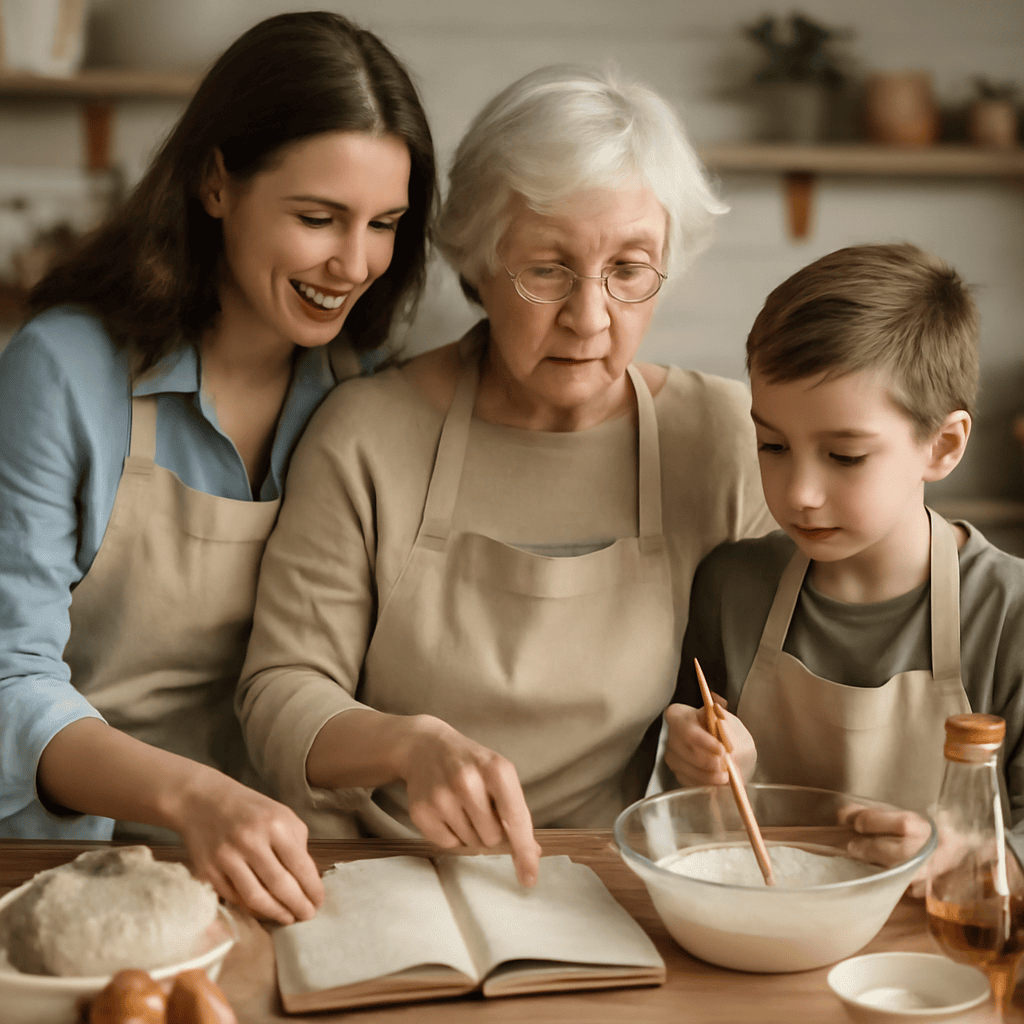
Why family recipes are so valuable
Family recipes are more than just cooking instructions – they are valuable treasures that carry stories, memories, and traditions within them. When you pass on your family recipes to your grandchildren, you are not only giving them culinary knowledge, but also a piece of your family history. These recipes connect generations and create an emotional bridge between the past and the future.
For your grandchildren, family recipes are a way to get to know you better and understand where they come from. When you cook together and tell the stories behind the recipes, you create unforgettable memories that will accompany your grandchildren throughout their lives. These shared moments at the stove are more valuable than any gift and strengthen the bond between you and your grandchildren.
When you pass on your recipes, you are doing something for your grandchildren that goes far beyond cooking. You are teaching them values such as tradition, family, and togetherness. Your grandchildren may later pass these recipes on to their own children, so that your culinary traditions remain alive across generations. This is a gift that will never be lost.
Emotional connection through food
Food has the special ability to evoke memories and awaken emotions. When your grandchildren later cook your recipes, they will remember the shared hours with you. The scent of grandma's apple cake or grandpa's goulash can open entire worlds of memories and convey the feeling that you are still with them, even if you are no longer there.
This emotional connection is something that will accompany your grandchildren throughout their lives. When they later cook themselves and use your recipes, they feel connected to you and your family history. This is especially valuable in difficult times when comfort and security are needed. Your recipes will become an anchor that provides stability and security.
As grandparents, you can actively promote this emotional connection by cooking together with your grandchildren and telling the stories behind the recipes. Tell them where the recipe comes from, who invented it, or what special moments are associated with it. These stories bring the recipes to life and create a deep emotional connection that will last across generations.
Preserving traditions for the future
Your family recipes are an important part of your family history and culture. When you pass them on to your grandchildren, you are not only preserving culinary knowledge, but also traditions that may have existed in your family for generations. These traditions are valuable and should not be lost.
For your grandchildren, it is important to know where they come from and what traditions their family has. When you pass on your recipes, you give your grandchildren the opportunity to learn about these traditions and understand what makes their family special. This strengthens their sense of belonging and gives them a feeling of continuity and stability.
When you document and pass on your recipes, you ensure that these traditions will remain alive in the future. Your grandchildren may later pass these recipes on to their own children, so that your culinary traditions are preserved across many generations. This is a valuable legacy that you can give to your grandchildren.
Documenting and organizing recipes
Before you can pass on your recipes, you should document and organize them well. Many recipes may only exist in your head or on faded pieces of paper. Take the time to write down these recipes so they are not lost and your grandchildren can use them later.
Good documentation makes it easier for your grandchildren to recreate the recipes later. Write down not only the ingredients and quantities, but also important details such as cooking times, temperatures, and special tips. The more detailed the instructions are, the easier it will be for your grandchildren to successfully recreate the recipe, even if you are no longer there.
When you document your recipes, you are doing something for your grandchildren that will bring them much joy later. You are not only giving them the opportunity to recreate your favorite dishes, but also the security that these recipes will be preserved forever. This documentation is a gift that your grandchildren will treasure throughout their lives.
Writing down recipes
Start by writing down your most important recipes. Write down not only the ingredient list and preparation steps, but also personal notes such as "Grandma always said that you have to let the dough rest for at least 30 minutes" or "This recipe tastes best when prepared the day before". These personal tips make the recipes especially valuable.
When you write down your recipes by hand, you give them a personal touch. Your grandchildren will later remember your handwriting and be happy when they read your notes. You can also add photos of the finished dishes or make small drawings that show how something should look. This makes the recipe collection a personal treasure.
Organize your recipes by categories such as appetizers, main courses, desserts, or by occasions such as Christmas, birthdays, or Sunday meals. This way, your grandchildren will quickly find what they are looking for later. You can also create a table of contents so that the recipe collection remains clear.
Using digital documentation
If you are familiar with digital devices, you can also document your recipes digitally. This has the advantage that recipes can be easily shared and will not be lost. You can save your recipes in a text document or a special recipe app and then share them with your grandchildren.
Digital documentation also makes it easier to update or adapt recipes. If you improve a recipe or try a new ingredient, you can simply enter the changes. Your grandchildren can then always use the latest version of the recipe. This is especially practical if you regularly adapt recipes.
If you use digital documentation, you can also add photos and videos. Show your grandchildren how you cook, or take photos of the individual steps. These visual aids will make it much easier for your grandchildren to recreate the recipes later, even if you are no longer there.
Cooking together with grandchildren
The best way to pass on your recipes is to cook together with your grandchildren. When you stand together at the stove, your grandchildren learn not only the recipes, but also the techniques, tips, and tricks that you cannot find in a cookbook. These shared hours are more valuable than any written instruction.
When cooking together, you can show your grandchildren how to season properly, how to tell if something is done, or how to knead dough. These practical skills are just as important as the recipes themselves. Your grandchildren will learn these techniques from you and can apply them later themselves.
When you cook together, you create not only culinary knowledge, but also unforgettable memories. Your grandchildren will later remember these shared hours and be happy when they recreate the recipes. These memories are a gift that will accompany your grandchildren throughout their lives.
Distributing age-appropriate tasks
When you cook with your grandchildren, it is important that you give them age-appropriate tasks. Younger children can, for example, wash ingredients, stir, or do simple things like cutting out cookies. Older children can already cut, season, or prepare simple dishes independently. Adapt the tasks to the age and abilities of your grandchildren.
It is important that your grandchildren feel useful and have success experiences. If the tasks are too difficult, they will become frustrated. If they are too easy, they will become bored. Find the right balance so that your grandchildren have fun cooking and are happy when they have accomplished something.
Let your grandchildren make mistakes too. Cooking is a learning process, and mistakes are part of it. If something is not perfect, that is okay. What is important is that you have fun together and that your grandchildren learn to cook independently. These learning experiences are just as valuable as perfect results.
Telling stories while cooking
While cooking together, you can tell the stories behind the recipes. Tell them where the recipe comes from, who invented it, or what special moments are associated with it. These stories bring the recipes to life and create an emotional connection that goes beyond cooking.
Perhaps you have memories of your own grandmother who taught you this recipe, or of special celebrations where this dish was always on the table. Share these memories with your grandchildren. They will be happy to hear these stories and understand where the recipes come from.
These stories are just as important as the recipes themselves. They convey not only culinary knowledge, but also family history and traditions. When your grandchildren later cook these recipes, they will remember these stories and feel connected to their family history. This is a valuable legacy that you can give to your grandchildren.
Adapting and modernizing recipes
Sometimes recipes need to be adapted to fit the needs and preferences of your grandchildren. Perhaps your grandchildren have allergies, eat vegetarian, or do not like certain ingredients. That is completely okay. Recipes are not set in stone, but can be adapted and modernized.
When you adapt recipes, you are doing something for your grandchildren that shows them that their needs are important. You show them that traditions are alive and can evolve without losing their core. This is an important lesson that your grandchildren can learn: traditions can be preserved even if they are adapted.
Together with your grandchildren, you can develop new versions of your recipes that take into account both tradition and modern needs. These adapted recipes may become new family traditions that your grandchildren will later pass on to their own children. This is a beautiful way to evolve traditions and keep them alive.
Finding healthy alternatives
When you adapt recipes, you can also find healthier alternatives. Perhaps you can use less sugar, take whole wheat flour instead of white flour, or use plant-based fats instead of animal fats. These adaptations not only make the recipes healthier, but also show your grandchildren that traditions can be modernized.
Together with your grandchildren, you can experiment and develop new variants. Perhaps the healthier version even tastes better, or you find a compromise that is both traditional and healthy. These experiments make cooking exciting and show your grandchildren that cooking can be creative and flexible.
It is important that you maintain the essence of the recipe. Even if you adapt ingredients, the dish should still be recognizable and have the character of the original recipe. This way, you can preserve traditions while modernizing them without losing their core.
Considering allergies and preferences
If your grandchildren have allergies or prefer certain dietary styles, it is important to take these into account. Perhaps you need to replace gluten, nuts, or dairy products. This is a challenge, but also an opportunity to be creative and develop new variants of your recipes.
Together with your grandchildren, you can search for alternatives and experiment until you find a version that everyone likes. Perhaps you will even discover new favorite recipes that taste just as good as the originals. These adapted recipes may become new family traditions that everyone can enjoy.
When you consider the needs of your grandchildren, you show them that their health and well-being are important. You also show them that traditions can be flexible and that recipes can be adapted without losing their essence. This is an important lesson that your grandchildren can learn.
Creating recipe books and collections
A personal recipe book is a wonderful gift for your grandchildren. You can create a recipe book that contains not only your recipes, but also personal notes, photos, and stories. This recipe book will become a valuable treasure that your grandchildren will keep throughout their lives.
When you create a recipe book, you are doing something for your grandchildren that shows them how important they are to you. You invest time and effort to create something that will bring them much joy later. This recipe book will become a link between you and your grandchildren, even if you are no longer there.
A recipe book can also be a beautiful shared activity. Let your grandchildren help with the design, add photos, or write their own notes. This way, the recipe book becomes a shared project that you create together and that your grandchildren will later have as a memory of the shared time.
Designing personal recipe books
When you create a personal recipe book, you can design it very individually. Add photos of the finished dishes, write personal notes for each recipe, or add small anecdotes associated with the recipe. This makes the recipe book a personal treasure that is much more than just a collection of recipes.
You can also create different categories, such as "Grandma's Favorite Recipes", "Holiday Recipes", or "Quick Dishes for Weekdays". This way, your grandchildren will quickly find what they are looking for later. You can also create a table of contents and number the recipes so that the book remains clear.
If you use handwritten recipes, you give the book a particularly personal touch. Your grandchildren will later remember your handwriting and be happy when they read your notes. You can also add small drawings or decorations that make the book even more personal.
Creating digital collections
If you create digital collections, you can easily share and organize your recipes. You can save your recipes in a cloud so that your grandchildren can access them from anywhere. This is especially practical if your grandchildren later want to cook themselves and use the recipes.
Digital collections also make it easy to update recipes or add new ones. If you try a new recipe or improve an old one, you can simply enter the changes. Your grandchildren can then always use the latest version without you having to create a new book.
You can also add photos, videos, or audio recordings that show how you cook. These visual and auditory aids will make it much easier for your grandchildren to recreate the recipes later. You can also add links to videos or websites that provide additional information or inspiration.
Special occasions and traditions
Special occasions such as Christmas, birthdays, or other celebrations are perfect opportunities to pass on family recipes. These recipes are often associated with special memories and traditions that are especially valuable for your grandchildren. When you cook these recipes together, you create not only delicious food, but also unforgettable memories.
For your grandchildren, these special recipes are a way to learn about the traditions of your family and understand what makes your family special. When you bake Christmas cookies together or prepare the birthday cake recipe, you create moments that your grandchildren will remember throughout their lives.
When you pass on these recipes, you ensure that these traditions will remain alive in the future. Your grandchildren may later pass these recipes on to their own children, so that your family traditions are preserved across many generations. This is a valuable legacy that you can give to your grandchildren.
Seasonal traditions
Many families have seasonal traditions associated with certain recipes. Perhaps you bake pumpkin cake in the fall, cookies in the winter, or ice cream in the summer. These seasonal recipes are a beautiful way to experience the rhythm of the year and create traditions that your grandchildren will love.
When you prepare these seasonal recipes together with your grandchildren, you create not only delicious food, but also special moments associated with the seasons. Your grandchildren will later remember these shared hours and be happy when they recreate these recipes to celebrate the season.
These seasonal traditions are valuable because they convey continuity and stability. When your grandchildren know that there is always pumpkin cake in the fall or cookies in the winter, it gives them a feeling of security and belonging. These traditions become anchors that provide stability and security.
Overcoming obstacles
Sometimes there are obstacles that make it difficult to pass on recipes. Perhaps you do not have enough time, your grandchildren live far away, or you feel insecure about cooking. That is completely okay. There are always ways to overcome these obstacles and still pass on your recipes.
If you do not have enough time, you might be able to arrange a fixed date per week or month when you cook together. Short videos or detailed written instructions can also help if you cannot be there personally. It is important that you find a way that works for you and your grandchildren.
If your grandchildren live far away, you can use video calls to cook together. You can also send recipe books by mail or create digital collections that your grandchildren can use from anywhere. There are many ways to pass on your recipes, even if you cannot be together in person.
Important Information for Recipe Documentation
Age-Appropriate Tasks When Cooking
Common Recipe Adaptations
Tips for Recipe Documentation
- Write down not only ingredients and quantities, but also personal tips and tricks
- Add photos of the finished dishes so your grandchildren know how they should look
- Tell the stories associated with the recipes
- Organize recipes by categories or occasions
- Create a table of contents for better overview
- Update recipes regularly when you find improvements
Ideas for Cooking Together with Grandchildren
- Start with simple recipes that quickly create success experiences
- Let your grandchildren help decide what to cook
- Tell stories about the recipes while cooking
- Take photos or videos of the shared cooking hours
- Celebrate the finished dish together and enjoy it together
- Praise your grandchildren for their help and successes
Gift Ideas for Recipe Books
- Personal recipe book with handwritten recipes and photos
- Digital recipe collection with videos and audio recordings
- Recipe box with handwritten recipe cards
- Jointly designed recipe book with grandchildren's notes
- Recipe book with stories and anecdotes for each recipe
- Seasonal recipe book with seasonal recipes