



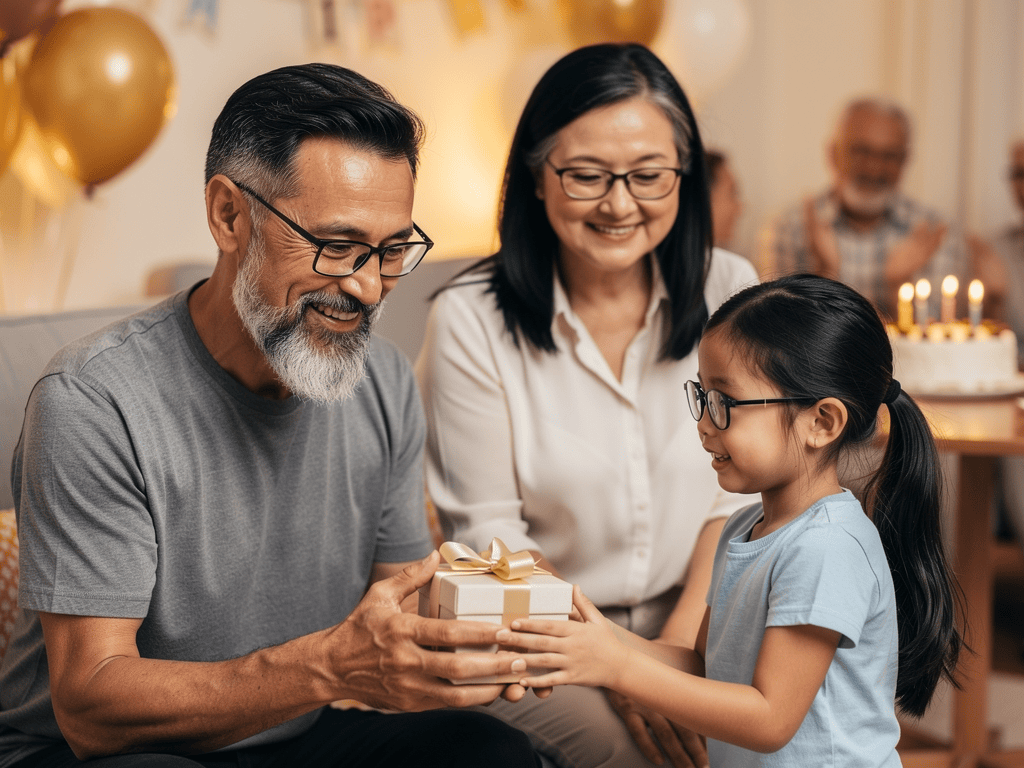
Why gift traditions are important
Gift traditions are more than just the exchange of material things. They create connection between generations, convey values, and create memories that will accompany your grandchildren throughout their lives. As grandparents, you have the special opportunity to establish traditions that not only bring joy in the moment but also have long-term significance.
When you establish gift traditions in your family, you give your grandchildren something valuable: the feeling of being part of a community that values values and maintains connection between generations. These traditions help your grandchildren develop their own identity and understand what is important in your family. They learn that gifts are not just material things, but expressions of love, appreciation, and connection.
Gift traditions can also help convey important values. For example, if you choose sustainable gifts or give shared experiences, you show your grandchildren that it is about more than consumption. You convey values such as sustainability, community, and the importance of experiences over material things. These values will shape your grandchildren and help them become responsible people.
Creating emotional connection
Gift traditions create an emotional connection between you and your grandchildren that goes beyond the material gift. When your grandchildren know that you always have a special gift or ritual on certain occasions, it creates expectation and anticipation. This anticipation is an important part of the tradition and helps strengthen the relationship between you and your grandchildren.
The emotional connection also arises from the regularity of the tradition. When your grandchildren know that you have a certain ritual every year at Christmas, on birthdays, or on another special occasion, it becomes a fixed part of their childhood and youth. These memories will accompany them throughout their lives and help them feel connected to their family.
The way you present gifts can also strengthen the emotional connection. When you take time to unwrap the gift together, talk about it, or tell a story about it, the gift becomes more than just an object. It becomes a moment of connection that your grandchildren will appreciate and remember fondly.
Conveying values
Gift traditions offer an excellent opportunity to pass on important values to your grandchildren. For example, if you choose sustainable gifts, you show your grandchildren that it is important to care for the environment. If you give shared experiences, you convey that time and experiences are more valuable than material things.
The way you choose and present gifts can also convey values. When you take time to find a personal gift, you show your grandchildren that it is important to think and make an effort. When you give handmade gifts, you convey that creativity and personal commitment are valuable.
Gift traditions can also help convey the value of community and family. When you present gifts as part of family celebrations or create shared rituals, you show your grandchildren that family is important and that it is nice to celebrate and rejoice together. These values will shape your grandchildren and help them become responsible and compassionate people.
Developing sustainable gift traditions
Sustainable gift traditions are those that last for years and remain meaningful to your grandchildren. They should not be one-time events, but regularly recurring and always bring joy. As grandparents, you can develop traditions that fit your family and that your grandchildren will appreciate.
It is important that the traditions fit you and your family. They do not have to be complicated or expensive – often it is the simple, regular rituals that mean the most. Think about what fits your family: Perhaps it is a special gift for each birthday, perhaps it is an annual tradition at Christmas, or perhaps it is something you do on another special occasion.
Sustainable traditions often develop over time. Start with something simple and let the tradition grow. Your grandchildren will show you what is important to them and what they appreciate. Listen to their reactions and adapt the traditions so they remain meaningful for everyone involved.
Seasonal traditions
Seasonal traditions are a wonderful way to establish gift traditions that regularly recur. For example, you can have a special gift or ritual for each Christmas, each birthday, or another annual occasion. This regularity creates expectation and anticipation in your grandchildren.
Seasonal traditions can also be connected to the seasons. Perhaps you give time together in the garden in spring, shared outings in summer, shared craft projects in autumn, and shared baking or cooking activities in winter. These traditions help your grandchildren experience and appreciate the seasons.
Special occasions during the year can also become traditions. Perhaps you give time together for Easter crafts at Easter, shared costumes at Halloween, or special activities at other holidays. These traditions help your grandchildren experience and understand the various holidays and occasions.
Personal rituals
Personal rituals are those developed specifically for individual grandchildren or for special occasions. Perhaps you have a special ritual for each grandchild that only applies to that child. Or perhaps you have a ritual that you perform on special milestones, such as the first day of school, confirmation, or other important events.
Personal rituals can also be connected to your grandchildren's interests and hobbies. If a grandchild is interested in music, for example, you can give a special musical experience each year. If a grandchild likes to read, you can establish an annual book tradition. These personal rituals show your grandchildren that you value and support their interests.
It is important that personal rituals do not become too complicated. They should be something you can regularly perform and that is meaningful to your grandchildren. Start with something simple and let the ritual grow if it proves successful. Your grandchildren will show you what is important to them and what they appreciate.
Choosing gifts with meaning
Gifts with meaning are those that go beyond the material and have a deeper significance. As grandparents, you can choose gifts that not only bring joy in the moment but also have long-term significance. These gifts help your grandchildren understand values and create memories that will accompany them throughout their lives.
Gifts with meaning can take various forms. They can be material gifts that have a special story or are connected to memories. But they can also be experiences that are shared and become special moments. Or they can be handmade gifts that show time, effort, and creativity.
It is important that the gifts fit your grandchildren and have a meaning that goes beyond the material. Think about what is important to your grandchildren and what will help them feel connected to their family. The best gifts are those that show you have thought about it and that you really know your grandchildren.
Experiences instead of things
Experiences are often more valuable than material gifts because they create memories that last a lifetime. As grandparents, you can give your grandchildren shared experiences that become special moments. These experiences help your grandchildren feel connected to you and create memories that will accompany them throughout their lives.
Shared experiences can take various forms. Perhaps you give a shared outing, a museum visit, a day at an amusement park, or another activity you can experience together. These experiences not only create memories but also the opportunity to spend time together and get to know each other better.
Experiences can also be connected to learning. Perhaps you give a shared course, a shared activity, or another experience that helps your grandchildren learn or discover something new. These experiences show your grandchildren that learning can be fun and that you support them in discovering new things.
Handmade gifts
Handmade gifts have special meaning because they show time, effort, and creativity. As grandparents, you often have the time and skills to make special gifts yourself that your grandchildren will appreciate. These gifts show your grandchildren that you have thought about it and that you are willing to invest time and effort.
Handmade gifts can take various forms. Perhaps you sew or knit something for your grandchildren, perhaps you craft something together, or perhaps you cook or bake something special. These gifts often have a personal touch and show your grandchildren that you know their interests and needs.
Handmade gifts can also become traditions. Perhaps you bake cookies together every year at Christmas, or perhaps you sew something every year on a special occasion. These traditions help your grandchildren understand that gifts do not always have to be bought, but that handmade gifts are often more valuable.
Creating shared rituals
Shared rituals are an important part of gift traditions. They help make gift giving something special and create moments of connection between you and your grandchildren. As grandparents, you can develop rituals that fit your family and that your grandchildren will appreciate.
Rituals can take various forms. Perhaps you have a special way of wrapping or presenting gifts. Perhaps you have a tradition of how you unwrap gifts or how you talk about them. Or perhaps you have a ritual you perform before or after gift giving.
It is important that the rituals fit you and your family and that they are performed regularly. Rituals become traditions through repetition, and these traditions help your grandchildren feel connected to their family and create memories that will accompany them throughout their lives.
Celebrating gift giving
The gift giving itself can become a special ritual. Perhaps you have a special way of wrapping gifts, or perhaps you have a tradition of how you present gifts. Perhaps you make gift giving a special moment by taking time to unwrap together and talk about it.
You can also connect gift giving with other rituals. Perhaps you read a story beforehand, sing a song, or perform another ritual that makes gift giving something special. These rituals help your grandchildren experience and appreciate gift giving as something special.
It is important that gift giving is not just quickly handled, but that you take time to enjoy the moment. When you show that gift giving is something special, your grandchildren will also learn to appreciate these moments and look forward to them.
Telling stories
Stories can be an important part of gift traditions. When you present gifts, you can tell stories about them: Perhaps you tell why you chose this gift, or perhaps you tell a story connected to the gift. These stories help your grandchildren understand the meaning of the gift and appreciate it.
Stories can also be told about the tradition itself. Perhaps you tell how the tradition came about, or perhaps you tell stories from previous years when you already performed the tradition. These stories help your grandchildren understand the tradition and feel connected to it.
Stories from your own childhood can also be helpful. When you tell which gift traditions you experienced as a child, you help your grandchildren understand that traditions are passed down through generations. These stories create connection between generations and help your grandchildren understand their own history.
Age-appropriate traditions
Gift traditions should be adapted to the age of your grandchildren. What is appropriate for a toddler may no longer be interesting for a teenager. As grandparents, you can develop traditions that grow with your grandchildren and adapt to their needs and interests.
It is important that you remain flexible and adapt traditions when your grandchildren get older. Traditions should not be rigid but should be able to evolve. When you show that you are willing to adapt traditions, your grandchildren will learn that traditions are alive and that they can evolve.
Age-appropriate traditions also help your grandchildren appreciate and look forward to the traditions. When the traditions fit their age, they are more likely to accept and appreciate them. Think about what is appropriate for each age and adapt the traditions accordingly.
Traditions for toddlers
For toddlers, simple, recurring traditions are best suited. Perhaps you give a certain toy or a certain book every year on a special occasion. Or perhaps you have a tradition of how you present gifts that is particularly exciting for toddlers.
Toddlers also appreciate rituals that actively involve them. Perhaps they can help with unwrapping, or perhaps you have a ritual in which they can actively participate. These rituals help toddlers understand the tradition and look forward to it.
It is important that traditions for toddlers are not too complicated. Simple, recurring rituals are best suited because they are easy to understand and because they create expectation and anticipation. When you establish simple traditions, your grandchildren will learn to appreciate them and look forward to them.
Traditions for school children
School children can already understand and appreciate more complex traditions. Perhaps you can develop traditions connected to their interests and hobbies. Perhaps you give something every year connected to a certain hobby or interest, or perhaps you have a tradition connected to learning or discovering.
School children also appreciate traditions in which they can actively participate. Perhaps they can help with preparation, or perhaps you have a tradition in which they can contribute something themselves. These traditions help school children feel connected to the tradition and appreciate it.
Traditions connected to school or learning can also be interesting for school children. Perhaps you give something special every year at the start of school, or perhaps you have a tradition connected to special achievements or milestones. These traditions show your grandchildren that you value and support their school achievements.
Traditions for teenagers
Teenagers appreciate traditions that treat them as equals and respect their growing independence. Perhaps you can develop traditions connected to their interests and goals, or perhaps you can adapt traditions so they better fit their age.
Teenagers also appreciate traditions that help them develop their own identity. Perhaps you can develop traditions connected to their hobbies, interests, or goals. These traditions show your grandchildren that you support their development and that you respect their growing independence.
It is important that you talk with your teenage grandchildren about the traditions and involve them in the design. When teenagers feel they can help shape the traditions, they are more likely to appreciate and maintain them. Show that you are willing to adapt traditions so they remain meaningful for everyone involved.
Adapting and evolving traditions
Traditions should not be rigid but should be able to evolve. As grandparents, you can adapt traditions when circumstances change or when your grandchildren get older. It is important that the traditions remain meaningful for everyone involved and that they bring joy.
When you adapt traditions, you should talk with your grandchildren about it. Explain why you want to adapt the tradition and listen to what your grandchildren have to say. When you show that you are willing to adapt traditions, your grandchildren will learn that traditions are alive and that they can evolve.
Traditions can also grow and evolve when new grandchildren join or when the family situation changes. It is important that you remain flexible and adapt traditions so they work for everyone involved. When you show that traditions can evolve, your grandchildren will learn that traditions are alive and that they can be part of them.
Documenting gift traditions
Documenting gift traditions can help keep them alive and pass them on to the next generation. As grandparents, you can take photos, write down stories, or use other forms of documentation to preserve the traditions.
Documentation can also help understand the meaning of traditions. When you write down why you developed a tradition or what it means to you, you help your grandchildren understand and appreciate the tradition. This documentation can also be valuable for future generations.
You can also make documentation part of the tradition itself. Perhaps you keep a book or album together with your grandchildren in which you record the traditions. This shared documentation can help strengthen the connection between you and your grandchildren and keep the traditions alive.
Overview of various gift traditions
Different types of gifts for traditions
Age recommendations for gift traditions
Tips for establishing gift traditions
- Start with simple, recurring traditions that are easy to implement
- Adapt traditions to the age and interests of your grandchildren
- Involve your grandchildren in designing the traditions
- Document traditions with photos or stories
- Be flexible and adapt traditions when circumstances change
- Take time for gift giving and make it a special moment
- Tell stories about the gifts and traditions
- Choose gifts with meaning that go beyond the material
Ideas for gift traditions
- Annual birthday gift with personal touch
- Christmas tradition with shared ritual
- Seasonal activity for each change of season
- School start gift for the first day of school
- Milestone gift for special events
- Handmade gift for a certain occasion
- Shared experience as a gift
- Tradition with stories and memories
Avoiding common mistakes when establishing traditions
- Do not make traditions too complicated – simple rituals are often best
- Do not introduce too many traditions at once – rather start slowly
- Do not keep traditions rigid – they should be able to evolve
- Do not overwhelm grandchildren – traditions should bring joy, not stress
- Do not forget to adapt traditions when grandchildren get older
- Do not force traditions – they should arise naturally
- Do not forget to explain the meaning of traditions
- Do not focus traditions too much on material things – experiences are often more valuable