


Why Balance Training is Important for Grandparents
As grandparents, you want to be able to stay active with your grandchildren for a long time – playing together, going for walks, or simply spending time together. Good balance is crucial here, as it helps you avoid falls and maintain your mobility. When you train your balance, you are not only investing in your own health, but also in the valuable time you can spend with your grandchildren.
Falls are one of the most common causes of injuries in old age, and they can lead to you being less mobile and spending less time with your grandchildren. Through regular balance training, you can significantly reduce your risk of falling while improving your mobility and strength. This means you can stay active longer and have more time with your grandchildren to create beautiful memories together.
Your grandchildren also benefit when you stay fit and active. You can play together, do sports, or simply go for a walk in the park without having to worry about your safety. When you train your balance, you also show your grandchildren how important it is to take care of your own health – a valuable lesson that will accompany them throughout their lives.
The Importance for Your Grandchildren
Your grandchildren need you as active, present grandparents who can play, laugh, and have adventures with them. When you train your balance and stay fit, you can fulfill this important role for a long time. Your grandchildren will appreciate being able to play with you on the playground, ride bikes together, or simply romp around in the garden.
Good balance also allows you to be safe with your grandchildren when you are caring for them. You can feel secure when going for walks with them, picking them up, or simply being active together. This security gives not only you, but also your grandchildren a good feeling and strengthens the bond between you.
When you stay active and train your balance, you also become a role model for your grandchildren. You show them that it is important to take care of your own health and that movement and fitness are important at any age. Your grandchildren will carry this lesson with them throughout their lives and may themselves become active, health-conscious people.
Health Benefits
Balance training has many health benefits that go beyond fall prevention. It improves your coordination, strengthens your muscles, and can even improve your cognitive function. When you regularly train your balance, you will feel overall fitter and better, which has a positive impact on all areas of your life.
Good balance also helps you maintain your independence. You can live alone longer, go shopping independently, and manage your daily activities without help. This means you can stay active longer and have more time to spend with your grandchildren without relying on the help of others.
Regular balance training can also help you feel more confident. When you know you can stand securely on your feet, you will also feel more secure in other situations. This confidence also transfers to your relationship with your grandchildren – you can interact with them more relaxed and confidently when you know you are physically fit.
Basics of Balance Training
Balance is a complex system that involves various parts of your body and brain. It is controlled by your inner ear, your eyes, your muscles, and your brain, which all work together to help you stand stable and move safely. When you understand how balance works, you can better understand why certain exercises are helpful.
As you age, various factors can affect your balance. Muscle strength can decrease, reaction time can slow down, and vision can deteriorate. These changes are normal, but through targeted training, you can counteract them and improve or at least maintain your balance.
The good news is that balance is trainable – even at an older age. Through regular exercises, you can significantly improve your balance ability, even if you may not have been as active for several years. It is never too late to start training, and even small progress can make a big difference for your safety and mobility.
How Does Balance Work?
Your balance system consists of three main components: the vestibular system in your inner ear, which detects movements and positions, your visual system, which helps you orient yourself in space, and your proprioceptive system, which tells you where your body parts are in space. These three systems work together to help you stand stable and move safely.
When you move, these systems send information to your brain, which processes this information and then sends signals to your muscles to adjust your posture. If one of these systems is not working properly or if communication between them is disrupted, your balance can be affected. Through targeted training, you can strengthen these systems and improve their cooperation.
Balance training aims to train all three systems and improve their cooperation. Through exercises that train your coordination, muscle strength, and reaction ability, you can strengthen your balance system and improve your stability. This not only helps you avoid falls, but also move more safely and confidently.
Age-Related Changes
As you age, various physical changes can affect your balance. Muscle strength can decrease, especially in the legs and core, making it more difficult to stand stable. Reaction time can slow down, meaning you may take longer to respond to changes in your environment.
Vision can also deteriorate, making it more difficult to orient yourself in space and recognize obstacles. The inner ear, which is important for balance, can also experience age-related changes. These changes are normal, but they can affect your balance if you do not actively train against them.
The good news is that through regular training, you can counteract these age-related changes. Even if you may not have the same strength or reaction time as in younger years, you can significantly improve your balance through targeted training and increase your safety. It is never too late to start training, and even small progress can make a big difference.
Simple Exercises for Home
You do not need to go to the gym or buy expensive equipment to train your balance. Many effective exercises can be done comfortably at home without special equipment. These exercises are easy to learn and can be adapted to your fitness level, so you can train at your own pace.
Start slowly and gradually increase. It is important that you do not overexert yourself and that you listen to your body. If you have pain or feel insecure, you should stop the exercise or choose an easier variation. Over time, you will make progress and can make the exercises more challenging.
Regularity is more important than intensity. It is better to train for a few minutes every day than to do one long training session per week. Try to make balance training a fixed part of your daily routine, similar to brushing your teeth or having your morning coffee. This way it becomes a habit and you will benefit from it in the long term.
Basic Exercises for Beginners
One of the simplest and most effective exercises for beginners is standing on one leg. Stand next to a chair or wall that you can use as support, and slowly lift one leg. Try to stand on one leg for 10 to 30 seconds, then switch legs. This exercise trains your balance while strengthening your leg muscles.
Another good exercise for beginners is marching in place with high knees. Alternately lift your knees as if you were marching in place. This exercise improves your coordination and balance while moving. You can also vary this exercise by moving your arms or changing the speed.
Standing on tiptoes is another simple exercise that you can do anywhere. Stand upright and slowly lift your heels so that you are standing on tiptoes. Hold this position for a few seconds and then slowly lower your heels again. This exercise strengthens your calf muscles and improves your balance.
Advanced Exercises
When you master the basic exercises, you can move on to more challenging exercises. A good exercise for advanced practitioners is standing on one leg with closed eyes. This exercise is significantly more difficult because you can no longer rely on your vision, but are completely dependent on your balance system. Start with short intervals and gradually increase.
Another advanced exercise is walking on a straight line, similar to a tightrope walker. Try to walk with one foot directly in front of the other, so that the heel of the front foot touches the toes of the back foot. This exercise trains your balance and coordination in motion. You can also do this exercise with closed eyes to make it even more challenging.
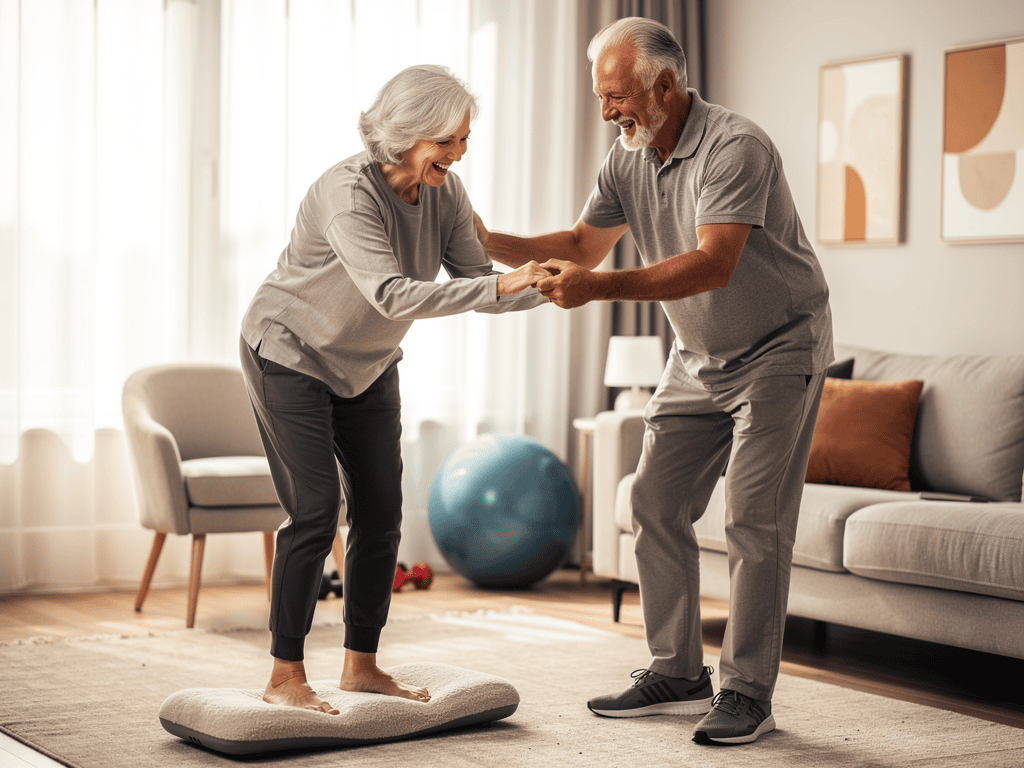
Standing on an unstable surface, such as a pillow or a rolled-up blanket, is another advanced exercise. This trains your balance system particularly intensively, as it constantly has to work to keep you stable. Start with both feet on the unstable surface and then try to stand on one leg when you feel secure.
Integrating Balance Training into Daily Life
You do not need to set aside extra time for balance training – you can easily integrate it into your daily life. For example, if you stand on one leg while brushing your teeth or do small balance exercises while waiting at the bus stop, you are training your balance without investing additional time. These small exercises add up throughout the day and can make a big difference.
You can also incorporate small balance exercises while cooking or talking on the phone. Try standing on one leg while standing at the stove, or make small weight shifts while talking on the phone. These activities are not only good for your balance, but also make daily life more varied and interesting.
When you integrate balance training into your daily life, it becomes a habit and you will hardly notice it anymore. You train your balance without it feeling like an additional burden, and you will benefit from it in the long term. Your grandchildren will appreciate it when you stay fit and active, and you can do more together.
Small Exercises in Between
There are many ways to incorporate small balance exercises into your daily life. For example, if you stand on one leg while brushing your teeth, you are training your balance while doing something you do every day anyway. You can also do small balance exercises while waiting at a traffic light or standing in line without anyone noticing.
You can also do balance exercises while watching TV. Try standing on one leg during commercial breaks or making small weight shifts. These small exercises are not only good for your balance, but also help use time productively. You will be surprised how much you can train without planning extra time for it.
When you integrate balance training into your daily life, it becomes a habit and you will hardly notice it anymore. You train your balance without it feeling like an additional burden, and you will benefit from it in the long term. Your grandchildren will appreciate it when you stay fit and active, and you can do more together.
Training Together with Grandchildren
Balance training can also be a wonderful shared activity with your grandchildren. Many balance exercises can be designed playfully, so that your grandchildren have fun and at the same time learn how important movement is. For example, you can stand on one leg together and see who can hold out longer, or do balance exercises together.
When you train together with your grandchildren, you not only show them how important movement is, but also spend valuable time together. Your grandchildren will appreciate it when you are active with them, and you can have fun together while both benefit from the health benefits. These shared activities also strengthen the bond between you and your grandchildren.
You can also invent games that include balance exercises to make training entertaining for both sides. For example, you can play "Statue" together, where you take different poses and try to maintain balance. Or you can balance together on a line and see who gets farthest. These playful activities make training motivating and entertaining for both sides.
Safety During Training
Safety is particularly important in balance training, as you can injure yourself if you fall. It is important that you always have support nearby that you can hold on to if you lose your balance. A chair, wall, or table are good options that you can use as support.
Always start with simple exercises and gradually increase. If you feel insecure or have pain, you should stop the exercise or choose an easier variation. It is better to progress slowly and stay safe than to overexert yourself and get injured. Your grandchildren need you healthy and active, not injured.
Wear comfortable clothing and shoes with good grip when training. Avoid slippery floors and make sure the area where you train is free of obstacles. If you feel insecure, you can also consult a physiotherapist or trainer who can help you choose the right exercises.
Avoiding Risks
To avoid risks in balance training, it is important that you are always careful and listen to your body. If you experience dizziness, nausea, or other unusual symptoms, you should stop training immediately and rest. It is better to skip a training session than to injure yourself.
Always start with simple exercises and gradually increase. If you feel insecure, you can also use support until you feel more secure. It is important that you do not overexert yourself and that you listen to your body. Your grandchildren need you healthy and active, not injured or overexerted.
Also avoid exercises that are too challenging for you. For example, if you have knee problems, you should avoid exercises that put a lot of strain on the knees. If you are unsure which exercises are suitable for you, you can consult a doctor or physiotherapist who can help you choose the right exercises.
When to See a Doctor?
If you have frequent falls, dizziness, or other symptoms that affect your balance, you should see a doctor. These symptoms can indicate underlying health problems that need to be treated. It is important that you stay healthy so that you can stay active with your grandchildren for a long time.
Also, if you have pain that is worsened by training, you should consult a doctor. Pain is a warning signal that should not be ignored. A doctor can help you find the cause of the pain and help you choose the right exercises that are safe for you.
If you are taking medications that can affect your balance, you should talk to your doctor before starting training. Some medications can cause dizziness or drowsiness, which can make balance training dangerous. Your doctor can help you understand the risks and ensure that training is suitable for you.
Long-Term Motivation
Long-term motivation is important so that you train regularly and benefit from it in the long term. Set realistic goals that you can achieve, and celebrate your progress. For example, if you have trained every day for a week, you can reward yourself or share your progress with your grandchildren.
It can also be helpful to document your progress so you can see how far you have come. For example, you can note how long you can stand on one leg, or how many repetitions of an exercise you can do. These records can be motivating and show you that you are making progress, even if it sometimes goes slowly.
Also remember why you are training – for your grandchildren. When you remember that you are training to stay active with your grandchildren for a long time, this can be very motivating. Your grandchildren are your greatest motivation, and when you think about how important it is to be there for them, it becomes easier to train regularly.
Setting Goals
Set realistic, achievable goals for your balance training. For example, you can set yourself the goal of training for 10 minutes every day, or you can set yourself the goal of holding a certain exercise for a certain time. It is important that the goals are achievable and that you do not overexert yourself.
Share your goals with your grandchildren or other family members who can support you. When others know about your goals, they can motivate you and help you stay on track. Your grandchildren will appreciate it when you show them that you set goals and work to achieve them.
Regularly adjust your goals depending on how your fitness level develops. If you make progress, you can set more challenging goals. If you have difficulties, you can adjust your goals so they remain achievable. It is important that you do not get discouraged and that you continue to train regularly.
Documenting Progress
It can be very motivating to document your progress so you can see how far you have come. For example, you can keep a small diary where you note which exercises you did and how long you trained. You can also note how long you can stand on one leg or how many repetitions of an exercise you can do.
When you document your progress, you can also see if you are regressing or if certain exercises are becoming more difficult. This can help you adjust your training routine and ensure that you continue to make progress. Your grandchildren can also help you document your progress, making the shared activity even more valuable.
Also celebrate small progress. For example, if you can stand on one leg for one second longer than last week, that is a success that should be celebrated. These small successes add up over time and can make a big difference for your health and mobility. Your grandchildren will be proud of you when you show them how far you have come.
Balance Training as a Shared Activity
Balance training can be a wonderful shared activity with your grandchildren. When you train together, you not only spend valuable time together, but also show your grandchildren how important movement and health are. Your grandchildren will appreciate it when you are active with them, and you can have fun together while both benefit from the health benefits.
You can also invent games that include balance exercises to make training entertaining for both sides. For example, you can play "Statue" together, where you take different poses and try to maintain balance. Or you can balance together on a line and see who gets farthest. These playful activities make training motivating and entertaining for both sides.
When you train together with your grandchildren, you also strengthen the bond between you. Your grandchildren will remember how you trained together, and these memories will accompany them throughout their lives. At the same time, you show your grandchildren that health and fitness are important at any age, and they will carry this lesson with them throughout their lives.
Exercise Overview for Balance Training
Safety Tips for Balance Training
Weekly Training Plan
Tips for Beginners
- Start slowly and gradually increase
- Always use support if you feel insecure
- Train regularly, even if it is only a few minutes
- Listen to your body and stop if you have pain
- Celebrate small progress and be patient with yourself
- Integrate training into your daily life so it becomes a habit
Motivation Helpers for Regular Training
- Remember why you are training – for your grandchildren
- Set realistic goals and celebrate your progress
- Document your progress to see how far you have come
- Train together with your grandchildren to have fun
- Share your goals with others who can support you
- Be patient and do not give up, even if it is sometimes difficult
Benefits of Balance Training
- Reduces fall risk and increases safety in daily life
- Improves mobility and flexibility
- Strengthens muscles, especially in legs and core
- Improves coordination and reaction ability
- Can improve cognitive function
- Increases self-confidence and feeling of security