



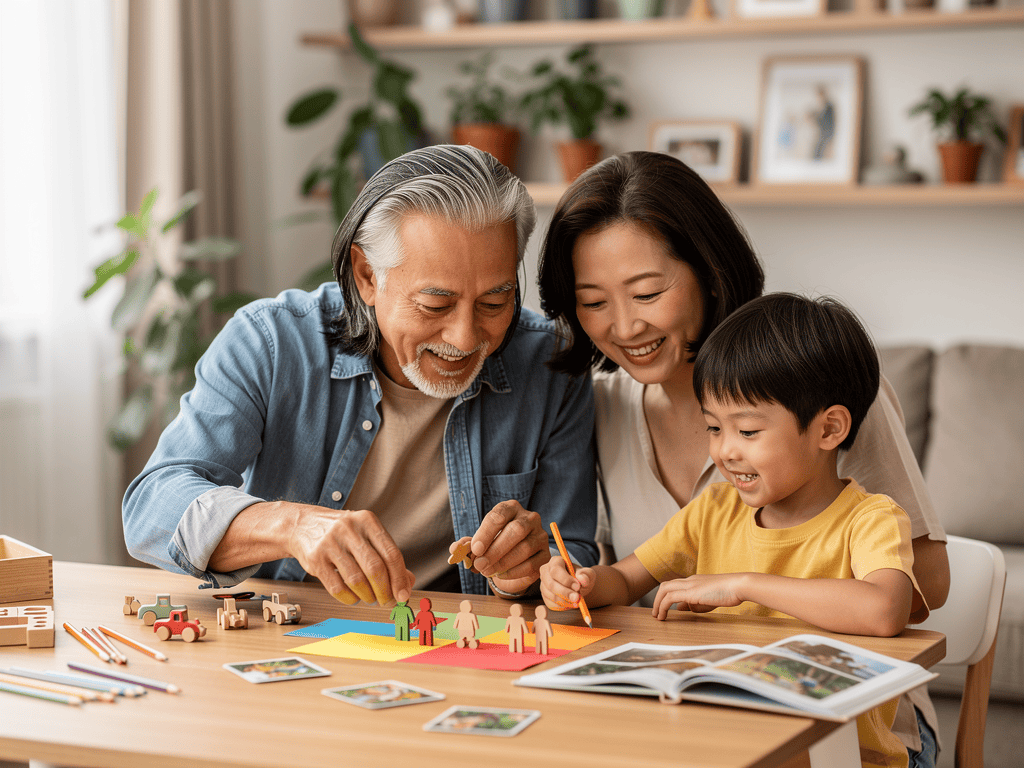
Why an organized household is important
A well-organized household is more than just order and cleanliness – it is the foundation for a relaxed life that gives you more time and energy for what really matters: your grandchildren. When you organize your household efficiently, you create space that you can use for shared activities, conversations, and valuable moments with your grandchildren.
Many grandparents find that household chores take more time in old age than they used to. Physical limitations, declining strength, or simply the habit of doing things differently can cause household tasks to take longer. A well-organized household helps you reduce this time while maintaining or even improving the quality of your household management.
When you organize your household efficiently, you are doing it not only for yourself but also for your grandchildren. An organized household means less stress, more time, and more energy – all things that help you be present and attentive when your grandchildren are with you. You can then focus fully on the shared time without constantly thinking about pending household tasks.
More time for grandchildren
When you organize your household efficiently, you gain valuable time that you can spend with your grandchildren. Instead of spending hours on household chores, you can use this time for shared activities: playing games, telling stories, cooking together, or simply being together. This time with your grandchildren is priceless and will become valuable memories for both you and your grandchildren.
An organized household also means you can be more spontaneous. When your grandchildren unexpectedly visit, you do not have to clean up for hours first, but can immediately look forward to the shared time. This flexibility makes being together with your grandchildren more relaxed and casual.
The time you gain through efficient household organization can also be used to plan new activities with your grandchildren. Perhaps you now have time for shared outings, for learning new hobbies, or simply for more conversations and shared moments. This investment in your relationship with your grandchildren is priceless.
Less stress in daily life
A well-organized household significantly reduces stress. When you know where everything is, when you have routines that work, and when you do not constantly have to search for things, you feel more relaxed and satisfied. This reduced stress has a positive impact on your health and well-being – and thus also on your ability to be there for your grandchildren.
Stress can cause you to be less patient and attentive when your grandchildren are with you. When you organize your household efficiently and thereby reduce stress, you can be calmer and more present. Your grandchildren sense this calm and feel more comfortable in your presence.
An organized household also helps you better cope with unexpected situations. When everything has its place and you have routines that work, you can respond more flexibly when something unforeseen happens – for example, when your grandchildren spontaneously visit or when you want to do something together.
Basic principles of household organization
The efficient organization of your household is based on some basic principles that help you bring structure and order into your daily life. These principles are not complicated, but they require some planning and discipline. However, the effort is worth it, because a well-organized household gives you more time and energy for your grandchildren.
The most important principles are: establishing routines, setting priorities, and simplifying instead of perfecting. When you follow these principles, you create a system that works for you and that you can maintain long-term. This system will help you run your household efficiently without feeling overwhelmed.
Remember: The organization of your household is not an end in itself, but a means to an end. The end is to have more time and energy for your grandchildren. When you always keep in mind during organization that it is about your grandchildren, it is easier for you to set the right priorities and not get lost in unimportant details.
Establishing routines
Routines are the key to an efficiently organized household. When you establish regular processes for recurring tasks, you do not have to think anew each time what needs to be done. Routines save time and energy and help you keep track.
Start with small routines: Perhaps you clean up the kitchen every evening before going to bed. Or you do a big shopping trip every Monday for the week. Or you clean the bathroom every Saturday morning. These small routines will become habits over time and require hardly any conscious effort.
Routines can also be flexible. You do not have to do the same thing at the same time every day. What is important is that you regularly complete certain tasks so they do not accumulate. When you establish routines that fit your life, you will find that the household almost runs by itself – and you have more time for your grandchildren.
Setting priorities
Not all household tasks are equally important. When you set priorities, you can focus on the really important tasks and leave less important things for later. This helps you run your household efficiently without feeling overwhelmed.
Think about which tasks are really important. Keeping the kitchen clean is probably more important than polishing all surfaces every day. Washing laundry is more important than cleaning all windows every day. When you have these priorities clear, you can use your time and energy purposefully.
Priorities can also change depending on what is coming up. When your grandchildren visit, it is more important to spend time with them than to be perfectly tidy. A bit of mess is okay if you can spend valuable time with your grandchildren instead. Remember: Your grandchildren will remember the shared time rather than a perfectly organized household.
Simplifying instead of perfecting
Perfectionism can be an obstacle to efficient household organization. When you try to do everything perfectly, you spend a lot of time on unimportant details and end up with less time for what really matters: your grandchildren. Instead, simplify your household management and focus on the essentials.
Simplifying does not mean you should become careless. Rather, it means setting realistic standards and not getting lost in details. A clean kitchen is more important than a perfectly polished stove. A tidy apartment is more important than having every drawer perfectly sorted. When you focus on the essentials, you save time and energy.
Simplifying can also mean doing certain tasks less frequently or approaching them differently. Perhaps you do not need to vacuum every day, but only twice a week. Perhaps you can combine certain cleaning tasks to save time. When you simplify your household management, you create more space for what really counts: your grandchildren.
Practical organization strategies
There are many practical strategies that help you organize your household efficiently. These strategies are tried and tested and can help you save time and energy. Try different strategies and find out which work best for you.
The most important strategies are: creating weekly planning, maintaining task lists, and setting time slots for housework. When you apply these strategies, you create structure and overview in your household. This structure helps you keep track and not forget important tasks.
Remember that each strategy should be adapted to your personal needs and lifestyle. What works for others does not necessarily have to work for you. Be flexible and adapt the strategies until you find a system that works well for you.
Creating weekly planning
A weekly plan helps you keep track of all pending household tasks and distribute them evenly over the week. Take a few minutes every Sunday to plan the coming week. Think about which tasks are coming up and when you can complete them.
Divide household tasks across different days so you do not have to do everything in one day. Perhaps you clean the bathroom on Mondays, the kitchen on Tuesdays, the living rooms on Wednesdays, and so on. This division makes housework more manageable and less burdensome.
Also consider your appointments and dates in your weekly planning, especially with your grandchildren. Plan household tasks so that you have enough time for shared activities. When you know that your grandchildren are visiting on the weekend, you can plan household tasks accordingly so you have time for them.
Maintaining task lists
Task lists help you keep track and not forget important tasks. You can maintain one large list for all tasks or several small lists for different areas (kitchen, bathroom, living room, etc.). Try what works best for you.
Write down all tasks that are coming up and cross them off when you have completed them. This gives you a good feeling of accomplishment and helps you stay motivated. You can also set priorities by marking important tasks or putting them at the top of the list.
Task lists can also be maintained digitally, for example with an app on your smartphone or tablet. This has the advantage that you always have the list with you and can easily update it. However, many older people find that a handwritten list on paper works better – try what works best for you.
Time slots for housework
Instead of spending the whole day on household chores, you can schedule fixed time slots for housework. For example, you can reserve one hour every morning for housework or 30 minutes every afternoon. These time slots help you limit housework and ensure you have enough time for other things.
During these time slots, you focus completely on housework and try to get as much done as possible. Outside these time slots, you do not do housework unless it is really urgent. This helps you find a healthy balance between housework and free time.
The time slots can be flexible and adapted to your needs. When you know that your grandchildren are visiting, you can reduce housework to a minimum. When you have more time, you can also tackle larger tasks. What is important is that you do not let yourself be overwhelmed by housework and always have enough time for your grandchildren.
Using tools and technologies
Modern tools and technologies can help you organize your household more efficiently. From household appliances that make work easier, to digital helpers for organization, to practical solutions for shopping lists and stockpiling – there are many options that save you time and energy.
You do not have to use all the latest technologies to organize your household efficiently. What is important is that you find the tools that work for you and that really help you. Try different options and find out what works best for you.
Remember: Every tool that saves you time and energy gives you more resources for your grandchildren. Invest in tools that help you run your household more efficiently so you have more time for what really matters.
Household appliances make work easier
Modern household appliances can take a lot of work off your hands and save you time. A dishwasher saves time when washing dishes, a clothes dryer saves time when drying laundry, and a vacuum robot can regularly vacuum without you having to be active yourself. These appliances are an investment that pays off when they save you time and energy.
Smaller appliances can also be helpful: An electric can opener makes opening cans easier, a mixer helps with meal preparation, and a water kettle saves time when cooking. Think about which appliances really help you and which you might not need.
When you consider purchasing new appliances, remember that it is about your grandchildren. Every appliance that saves you time gives you more time for shared activities. Invest in appliances that help you run your household more efficiently so you have more time for your grandchildren.
Digital helpers for organization
Digital helpers can help you organize your household better. There are apps for shopping lists, for task planning, for recipes, and for much more. These apps can help you keep track and not forget important tasks.
Many older people are initially skeptical about digital helpers, but many find that after a short adjustment period they are very helpful. If you have a smartphone or tablet, you can try different apps and find out which are useful for you.
You do not have to use all digital helpers – choose those that are really helpful for you. Perhaps a shopping list app is useful for you, but a task planning app is not. Try what works for you and only use the tools that really help you.
Shopping lists and stockpiling
A well-maintained shopping list helps you not forget anything and not make unnecessary purchases. You can maintain a handwritten list or use an app – what is important is that you regularly update the list and have it with you when shopping.
Stockpiling can help you be more spontaneous and have to shop less often. Keep basic foods and frequently used ingredients in stock so you do not have to shop anew for every recipe. This saves time and gives you more flexibility.
When you regularly have your grandchildren with you, you can also create special stocks for them. Perhaps you keep certain snacks, drinks, or toys in stock so you have something for your grandchildren when they visit. This makes being together more relaxed and casual.
Involving grandchildren in household organization
One of the most beautiful ways to organize your household efficiently is to involve your grandchildren. Shared household tasks can become valuable moments in which you spend time together while doing something meaningful at the same time. Your grandchildren also learn important life skills and develop an understanding of responsibility.
When you involve your grandchildren in household organization, you are not only doing something for your household but also for your relationship with your grandchildren. Shared tasks create connection and give you the opportunity to have conversations and spend time together. This shared time is valuable, even when you are doing household tasks.
What is important is that the tasks are age-appropriate and that your grandchildren do not feel overwhelmed. Start with small, simple tasks and gradually increase responsibility. Praise your grandchildren for their help and show them that their support is important and appreciated.
Shared tasks as time together
Shared household tasks can become beautiful moments in which you spend time with your grandchildren. When you cook together, clean up together, or work in the garden together, you have the opportunity to have conversations, tell stories, and simply spend time together. This shared time is valuable, even when you are working.
Use the shared time for conversations about various topics. Perhaps you tell stories from your childhood, listen to what your grandchildren have to tell, or talk about current topics. These conversations during shared work create connection and help you get to know your grandchildren better.
Shared tasks can also be playful. Make a game out of who cleans up faster, or sing songs together during work. These playful elements make housework more pleasant and create positive memories that your grandchildren will remember for a long time.
Age-appropriate tasks for grandchildren
Younger grandchildren can take on simple tasks: putting away toys, setting the table, carrying light objects. These tasks give them a sense of responsibility and help them feel useful. What is important is that the tasks match their age and abilities.
Older grandchildren can take on more complex tasks: helping with cooking, drying dishes, light cleaning work. These tasks help them develop important life skills and gain an understanding of household management. At the same time, they give you the opportunity to spend time together.
Teenage grandchildren can take on even more responsibility: cooking independently, larger cleaning tasks, doing shopping. These tasks help them become more independent and develop important skills for later life. At the same time, they relieve you and give you more time for other things.
Transferring responsibility
When you transfer responsibility to your grandchildren, you help them become more independent and responsible. At the same time, you relieve yourself and create more time for other things. What is important is that the responsibility is age-appropriate and that your grandchildren do not feel overwhelmed.
Start with small responsibilities and gradually increase them. Perhaps your grandchild is initially responsible for putting away toys, later for setting the table, and eventually for certain cleaning tasks. This gradual transfer of responsibility helps your grandchildren feel secure and develop their abilities.
Praise your grandchildren for their responsibility and show them that their help is important. When they make mistakes, be patient and help them learn from them. This positive support helps your grandchildren develop self-confidence and enjoy taking responsibility.
Energy-saving household management
In old age, it is important to conserve your physical resources and develop efficient workflows. When you organize your household so that you use less energy, you have more strength for what really matters: your grandchildren. Energy-saving household management helps you stay active longer and spend more time with your grandchildren.
Efficient workflows save not only time but also energy. When you organize your household tasks so that you do not constantly have to run back and forth, you save strength. When you divide heavy tasks or use tools, you protect your body. These small adjustments can make a big difference.
Remember: Every energy you save through efficient household management is available for your grandchildren. When you organize your household so that you are less tired, you can stay active longer and spend more time with your grandchildren. This investment in your energy is worth it.
Conserving physical resources
In old age, it is important to conserve your physical resources. Avoid heavy lifting, use tools such as trolleys or carts, and divide large tasks into smaller steps. These adjustments help you conserve your strength and stay active longer.
Plan your household tasks so that you do not have to do everything in one day. Distribute tasks across the week so you are not overtired. Take regular breaks and listen to your body. When you are tired, it is okay to take a break or postpone a task until later.
Use tools that make work easier for you. A vacuum cleaner with a long hose saves bending, a laundry basket on wheels saves carrying, and an adjustable ironing board saves back strain. These small tools can make a big difference and help you conserve your strength.
Efficient workflows
Efficient workflows save time and energy. When you organize your household tasks so that you do not constantly have to run back and forth, you save strength. Plan your tasks so that you have everything you need for a specific task in one place before you start.
Combine similar tasks to save time. When you are already in the kitchen, you can do several things at once: wash dishes, clean the kitchen, take out trash. This combination of tasks saves time and energy because you do not have to go to the kitchen multiple times.
Use waiting times productively. While the water is boiling, you can clean up the kitchen. While the washing machine is running, you can do other tasks. This efficient use of time helps you accomplish more without feeling overwhelmed.
Building long-term organization
Efficient household organization is not a one-time project but a long-term process. When you establish systems that work for you and regularly review and adjust them, you create sustainable organization that helps you long-term. This long-term organization gives you more time and energy for your grandchildren.
What is important is that you remain flexible and adapt your organization to changed circumstances. Perhaps your physical abilities change, perhaps your needs change, or perhaps your grandchildren's needs change. Good organization adapts to these changes and remains helpful long-term.
Remember that the organization of your household is a means to an end. The end is to have more time and energy for your grandchildren. When you always keep in mind during organization that it is about your grandchildren, it is easier for you to make the right decisions and build organization that is really helpful.
Establishing systems
Good systems are the foundation for long-term, efficient household organization. When you establish systems that work for you, you do not constantly have to think anew about what needs to be done. The systems run almost by themselves and give you more time for other things.
A system can be, for example: Planning the week every Sunday, reserving one hour every morning for housework, cleaning up the kitchen every evening. These recurring processes become habits and require hardly any conscious effort. When you establish such systems, you create sustainable organization.
Systems can also apply to specific areas: Perhaps you have a system for laundry, a system for shopping, a system for cleaning. These specific systems help you work efficiently in every area of the household. When you establish and maintain these systems, you have a well-organized household long-term.
Regular review
Good organization requires regular review and adjustment. Regularly take time to review whether your systems still work, whether they still match your needs, and whether they are still helpful. When something no longer works, adapt it or change it.
Perhaps you find that certain routines no longer match your life or that certain strategies are no longer helpful. That is completely okay – good organization is flexible and adapts to changed circumstances. What is important is that you regularly review and adjust.
Also use the review to reflect on whether you have achieved your goals. Do you have more time for your grandchildren? Do you feel less stressed? Is the household running more efficiently? If yes, you have achieved your goal. If no, think about what you can change to achieve your goals.
Example of weekly planning
Age-appropriate tasks for grandchildren
Tools for efficient household management
Tips for establishing routines
- Start with small, simple routines
- Choose routines that fit your life
- Be patient – routines need time to become habits
- Adapt routines when they do not work
- Combine routines with pleasant activities
- Praise yourself when you have successfully established routines
Strategies for simplifying
- Focus on the essentials
- Set realistic standards
- Let go of perfectionism
- Combine similar tasks
- Use tools that make work easier
- Prioritize tasks by importance
Shared household tasks with grandchildren
- Cooking and baking together
- Cleaning up and organizing together
- Working in the garden together
- Sorting and folding laundry together
- Going shopping together
- Making or hanging decorations together