



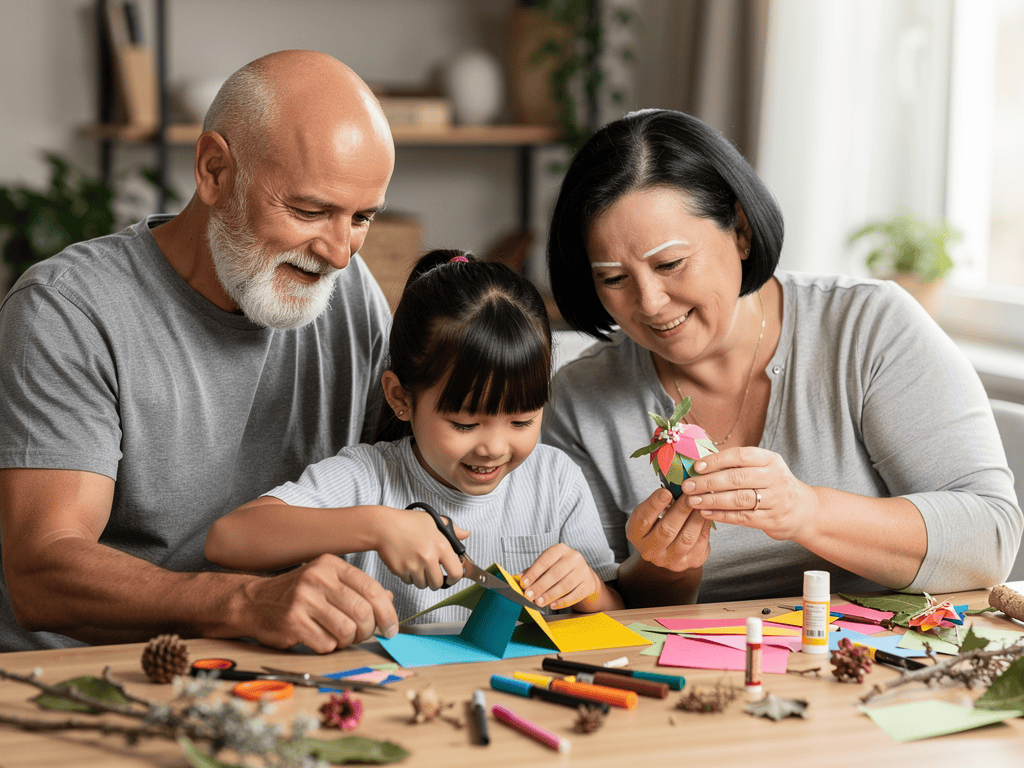
Why writing together with grandchildren is so valuable
Writing together with your grandchildren is more than just an activity – it is a wonderful way to foster creativity, support language development, and create valuable memories that will last forever. When you write together with your grandchildren, you not only give them a creative tool, but also create moments of connection that will strengthen your relationship and shape your grandchildren.
Writing is one of the most important skills children can develop, and as grandparents, you have the unique opportunity to support your grandchildren in finding joy in writing. When you develop stories together, capture memories, or implement creative projects, you show your grandchildren that writing is not just a school task, but a means to express themselves, share ideas, and explore the world. This attitude toward writing will accompany your grandchildren throughout their lives and help them go through life confidently and creatively.
Shared writing projects also create a special form of connection between you and your grandchildren. When you work together on a story or write down memories, a space is created for conversations, for sharing thoughts and feelings, for discovering common interests. These moments of collaboration and shared creation strengthen your relationship and create memories that both you and your grandchildren will carry in your hearts forever.
Fostering creativity and language development
When you write together with your grandchildren, you foster their creativity in many ways. Writing stimulates imagination, encourages thinking and experimentation, and helps children put their thoughts and ideas into words. When your grandchildren see how you develop stories, collect ideas, and choose words, they learn not only the craft of writing, but also how to think creatively and solve problems.
At the same time, you support your grandchildren's language development. When you write together, you use new words, discuss word choice and sentence structure, and your grandchildren naturally learn to expand their language skills. This playful way of learning is particularly effective because it is fun and does not feel like a school task. Your grandchildren will not only improve their writing skills, but also expand their vocabulary and learn to express themselves more precisely.
Writing also promotes your grandchildren's cognitive development. When they develop stories, they must make connections, follow plot lines, and think logically. These skills are not only important for writing, but also help your grandchildren in many other areas of life. When you write together, you support your grandchildren in developing these important cognitive skills and give them tools they will use throughout their lives.
Strengthening shared time and bonds
Shared writing projects create valuable time you can spend with your grandchildren. When you work together on a story or write down memories, a space is created for conversations, for sharing thoughts, and for discovering common interests. These moments of collaboration are particularly valuable because they create a deep connection that goes beyond writing.
When you write together, you get to know your grandchildren better – their thoughts, their imagination, their way of seeing the world. At the same time, your grandchildren also get to know you better – your stories, your values, your way of thinking. This exchange strengthens your relationship and creates a sense of connection that will accompany your grandchildren throughout their lives. The stories you write together become part of your shared history and memories that you will both share forever.
Writing projects also offer the opportunity to talk about important topics that might not come up so easily in everyday life. When you develop stories together, you can talk about values, feelings, challenges, and dreams without it feeling like a lecture. These conversations help your grandchildren understand and process their thoughts and feelings, and give you the opportunity to share your wisdom and experience.
Preserving memories for the future
When you write together with your grandchildren, you not only create beautiful moments in the present, but also valuable memories for the future. The stories you develop together, the memories you write down, and the projects you implement become a treasure that your grandchildren will keep for their entire lives. These written memories are particularly valuable because they freeze time and capture moments that might otherwise be forgotten.
A book written together or a diary becomes an heirloom that reminds your grandchildren of the time with you, even if you may no longer be there. These written testimonies of your shared time are a gift that can be passed down through generations. When your grandchildren later read these stories, they will remember the moments you spent together, and the connection to you will still be felt even when you are no longer physically present.
Written memories also help preserve family history. When you write down family stories or document memories together with your grandchildren, you create an archive that will be valuable for future generations. Your grandchildren will not only appreciate these stories as memories of the time with you, but also as part of their own family history, which they can pass on to their own children.
Simple writing projects to get started
If you don't have experience with shared writing projects yet, it's best to start with simple projects that are fun and not overwhelming. Simple projects help you and your grandchildren get used to writing together and collect first successes that motivate you to continue.
It's important that you don't expect perfect results, but that you enjoy the process and have fun together. Writing should be a positive experience for your grandchildren, not a mandatory task. When you start with simple projects, you and your grandchildren can discover the joy of writing and gradually move on to more complex projects when you're both ready.
Simple writing projects can also be very creative and produce wonderful results. Often it's the simple ideas that are the most fun and create the best memories. Start with projects that match your grandchildren's interests, and let yourself be inspired by their enthusiasm.
Developing stories together
One of the simplest and most beautiful ways to write together is to develop a story together. You can start by suggesting the first sentence, and then take turns: you write a sentence or paragraph, then it's your grandchild's turn, then you again. This way, a story is created that you both created together, and which often takes surprising turns because you both bring in your own ideas.
You can also suggest a topic – for example "A Trip to the Moon" or "The Adventure in the Magic Forest" – and then develop the story together. Let your grandchildren use their imagination and encourage them to bring in creative ideas. When you develop a story together, your grandchildren learn not only writing, but also how to develop ideas, follow plot lines, and structure a story.
You can then illustrate the finished story together, bind it in a beautiful book, or even perform it as a small play. These shared projects make writing an experience that goes beyond writing and create memories your grandchildren will never forget.
Keeping a diary or memory book
Keeping a shared diary or memory book is a wonderful way to capture memories while regularly writing together. You can buy a beautiful notebook or design one yourself, and then regularly – for example once a week or after special events – write entries together.
In the diary, you can write everything you have experienced together: trips, special moments, conversations, thoughts, and feelings. Let your grandchildren write or dictate their own entries, and add your own thoughts and memories. This way, a book full of shared memories is created that you will both enjoy browsing through again and again.
A shared diary can also be a place where you can talk about important topics without it feeling like a lecture. When you write together about experiences, you can also talk about values, feelings, and life experiences. These conversations that arise in writing are particularly valuable because they are natural and relaxed.
Writing letters and postcards
Writing letters and postcards is a beautiful tradition that you can revive together with your grandchildren. When you write letters together to family members, friends, or even to yourselves, your grandchildren learn not only writing, but also how to formulate personal messages and build connections with other people.
You can also establish a pen pal relationship between your grandchildren and other children, or even between you and your grandchildren if you don't live nearby. Regular letters create a connection that bridges distance and give your grandchildren the opportunity to share their thoughts and experiences. This written communication is particularly valuable because it gives time to think and creates a form of connection that is different from phone calls or video calls.
Letters and postcards can also be written on special occasions – for example on birthdays, holidays, or simply to show someone that you're thinking of them. When you write letters together, you show your grandchildren how important it is to maintain connections with other people and invest time to make others happy.
Writing down family stories together
Family stories are a treasure that is often lost if they are not written down. When you write down family stories together with your grandchildren, you not only preserve important memories, but also give your grandchildren a sense of their origin and family history.
Writing family stories together is also a wonderful way to share your own story and let your grandchildren participate in your life experience. When you tell stories from your childhood and write them down together, you give your grandchildren insights into a time they didn't experience themselves, and help them understand where they come from and what traditions shape their family.
Family stories also create a connection between generations. When you write down stories together that have been passed down from generation to generation, these stories become part of your grandchildren's identity. These written testimonies of family history are a legacy that will accompany your grandchildren throughout their lives and that they can pass on to their own children.
Telling stories from your childhood
Stories from your own childhood are particularly interesting for your grandchildren because they provide insights into a time they didn't experience themselves. When you write down these stories together, you can not only preserve memories, but also show how the world has changed and what values and traditions have shaped your family.
Tell about special experiences, adventures, friends, family celebrations – everything that shaped your childhood. Let your grandchildren ask questions and encourage them to share their own thoughts and feelings about the stories. When you write down these stories together, a book full of memories is created that your grandchildren will enjoy reading again and again.
These stories also help your grandchildren understand you better and see that you were once a child too. When you tell about your own experiences, you show your grandchildren that you understand their feelings and challenges because you've had similar experiences. This connection creates a special closeness between you and your grandchildren.
Documenting family traditions
Every family has its own traditions – special celebrations, rituals, recipes, stories that are passed down from generation to generation. When you write down and document these traditions together with your grandchildren, you not only preserve important family traditions, but also give your grandchildren a sense of their cultural identity.
Document recipes together that have been passed down in your family for generations, special celebrations and rituals, stories about family members who were important, and everything that makes your family. Let your grandchildren add their own thoughts and memories to these traditions, and create a living document of your family history.
This documentation becomes an heirloom that your grandchildren will keep for their entire lives. When they later have their own children, they can pass on these traditions and thus keep the family history alive. The written documentation ensures that important traditions are not lost and that future generations have access to their family history.
Creating a family book
A family book is a comprehensive project that summarizes all aspects of your family history. You can create a book together with your grandchildren that contains stories, photos, recipes, family trees, traditions, and everything else that makes your family. This book becomes a valuable heirloom that can be passed down through generations.
Work together on different chapters – for example a chapter about your childhood, a chapter about important family members, a chapter about traditions and celebrations, a chapter about recipes. Let your grandchildren add their own contributions – their thoughts, their memories, their drawings – and create a book that was truly created together.
A family book can also be an ongoing project that grows over the years. When new stories emerge, new family members join, or new traditions develop, you can add them to the book. This way, the family book becomes a living document of your family history that grows and evolves over time.
Trying out creative writing forms
Writing doesn't always have to be in the form of stories or diary entries – there are many creative writing forms that you can try together with your grandchildren. Different writing forms promote different skills and make writing varied and exciting.
When you try different writing forms, you show your grandchildren that writing can be diverse and creative. Poems, fairy tales, comics, song lyrics – all these forms have their own rules and possibilities, and when you explore them together, you not only expand your grandchildren's writing skills, but also their creativity and understanding of language.
Creative writing forms can also be particularly motivating because they often lead to results faster than long stories. A poem or a short comic can be completed in one session, which gives your grandchildren a sense of achievement and motivates them to continue.
Writing poems and rhymes
Writing poems and rhymes is a wonderful way to play with language and foster creativity. Poems don't have to be complicated – simple rhymes, haikus, or free verse can be just as beautiful and creative as complex poems. When you write poems together, your grandchildren learn to play with words, find rhythm, and put emotions into words.
Start with simple rhymes – for example about animals, seasons, or everyday things. Let your grandchildren bring in their own ideas and encourage them to be creative. You can also write a poem together about a special experience – for example about a trip or a family celebration. This way, the poem becomes a memory that is captured in a special form.
Poems can also be illustrated, which makes the project even more creative. When you write and illustrate poems together, small works of art are created that your grandchildren can proudly present. These poems can also be collected in a small book that becomes a treasure your grandchildren will enjoy browsing through again and again.
Fairy tales and fantasy stories
Fairy tales and fantasy stories are particularly popular with children because they stimulate imagination and transport them to magical worlds. When you write fairy tales together with your grandchildren, you can use traditional fairy tale elements – for example princesses, dragons, wizards – or invent completely new worlds and characters.
Let your grandchildren use their imagination and encourage them to bring in creative ideas. You can create a world together, develop characters, and build an exciting plot. When you write a fairy tale together, your grandchildren learn not only writing, but also how to structure stories, build tension, and develop characters.
Fairy tales can also contain important messages – for example about friendship, courage, helpfulness, or justice. When you write fairy tales together, you can naturally incorporate these messages without it feeling like a lecture. This way, your grandchildren learn important values while having fun and being creative.
Comics and picture stories
Comics and picture stories combine writing with drawing and are therefore particularly attractive for children who like to draw. When you create comics together, your grandchildren can not only develop their writing skills, but also use their artistic skills. This combination makes the project particularly motivating and fun.
Start with simple picture stories – for example a story in four pictures with short texts. Let your grandchildren draw the pictures and help them write appropriate texts. When you create comics together, your grandchildren learn how to tell a story visually and how text and image work together.
Comics can also be about everyday things – for example about experiences with the family, trips, or special moments. When you create comics together about real experiences, they become memories that are captured in a special form. The finished comics can be collected in a book or even presented as a small exhibition.
Age-appropriate projects for different age groups
Depending on your grandchildren's age, different writing projects are suitable. It's important to choose projects that match your grandchildren's developmental stage and that neither overwhelm nor underchallenge them. When you choose age-appropriate projects, you ensure that your grandchildren have success experiences and find joy in writing.
For younger children, projects should be simple and playful, while older children can implement more complex projects. It's important that you are flexible and adapt the projects to your grandchildren's abilities and interests. If a project is too difficult, simplify it; if it's too easy, add challenges.
Age-appropriate projects also help maintain your grandchildren's motivation. If the projects are too difficult, your grandchildren will become frustrated; if they're too easy, they'll become boring. When you find the right balance, your grandchildren stay motivated and enjoy writing together.
Projects for preschoolers
For preschoolers, writing projects should be very simple and playful. Since these children can't write yet themselves, you can write down their stories while they tell them, or you can create picture stories together where the pictures are in the foreground and only short texts are added.
You can also develop rhymes together, write simple song lyrics, or tell stories that you then write down. It's important that the projects are fun and that the children feel that their ideas are important. Let the children illustrate their stories and create small books that they can proudly present.
For preschoolers, it's also nice when you regularly read stories together and then talk about them. These conversations help children understand stories and develop ideas that they can then incorporate into their own stories. When you read and talk about stories together, you also create a foundation for writing together.
Projects for elementary school children
Elementary school children can already write themselves and are ready for more complex projects. You can develop longer stories together, keep diaries, write letters, or implement creative projects like poems or comics. It's important that you adapt the projects to your grandchildren's writing skills and help them when they have difficulties.
Elementary school children often have a lot of imagination and are enthusiastic about creative projects. Use this enthusiasm and encourage your grandchildren to bring in their ideas. You can also work together on projects that span multiple sessions – for example a longer story or a family book. These larger projects give your grandchildren a sense of achievement and show them that writing is a process that takes time.
For elementary school children, it's also important that they have success experiences. Praise their ideas and writing skills, even if the texts aren't perfect yet. Show that you're proud of their work and that their stories are valuable. This positive reinforcement helps your grandchildren find joy in writing and become confident.
Projects for teenagers
Teenagers can already implement very complex projects and often have their own interests and ideas. You can work together on more demanding projects – for example longer stories, poems, essays, or even a blog or digital book. It's important that you respect your grandchildren's interests and help them implement their own ideas.
Teenagers also appreciate it when you take their work seriously and give constructive feedback. You can work together on texts, discuss ideas, and refine the projects. When you work together on demanding projects, you show your grandchildren that you respect their abilities and that you see them as equal partners in the writing process.
For teenagers, digital projects can also be particularly interesting – for example creating a blog, writing e-books, or creating digital storybooks. These projects use teenagers' technical skills and show them how writing can be used in the digital world. When you implement digital projects together, you also learn from each other and create something that is modern and relevant.
Practical tips for successful writing projects
For shared writing projects to be successful, it's important to create the right atmosphere and maintain your grandchildren's motivation. With a few simple tips, you can ensure that writing together becomes a positive experience that both you and your grandchildren enjoy.
It's important that you are patient and don't expect perfect results. Writing is a process that takes time, and especially for children, it can be difficult to put their thoughts into words. When you are patient and support your grandchildren without correcting or criticizing them, you create a safe environment where creativity can thrive.
Let your grandchildren develop their own ideas and encourage them to be creative. You don't always have to set the direction – often children have the best ideas when you give them the freedom to use their imagination. When you develop and discuss ideas together, the most creative and interesting projects often emerge.
Creating the right atmosphere
A quiet and relaxed atmosphere is important for creative writing to succeed. Find a place where you are undisturbed and where your grandchildren feel comfortable. Maybe you have a cozy spot in the living room, a desk in the study, or even a spot in the garden where you like to write.
Also create a pleasant environment – for example with a cup of tea or cocoa, with nice music in the background, or with candlelight. These small details make writing a special experience and show your grandchildren that this time is important and valuable. When you create a nice atmosphere, your grandchildren will associate writing together with positive feelings.
It's also important that you plan enough time. Writing shouldn't be rushed, but relaxed and creative. Plan sufficient time so that you and your grandchildren can work in peace without being under time pressure. When you regularly plan time for shared writing projects, writing becomes a beautiful habit that both of you can look forward to.
Fostering motivation and enthusiasm
Maintaining your grandchildren's motivation is important for writing together to be successful in the long term. Show enthusiasm for the projects and your grandchildren's ideas, and praise their creativity and writing skills. When you show that you're proud of their work, your grandchildren will stay motivated and enjoy writing.
You can also create small rewards or incentives – for example that you read the finished stories together, that you bind them in a beautiful book, or that you present them to the family. These small incentives make writing a special experience and give your grandchildren a sense of achievement.
It's also important that you respect your grandchildren's interests and choose projects that really interest them. If your grandchildren are enthusiastic about certain topics – for example animals, adventures, or fantasy stories – use these interests for your writing projects. When the projects match your grandchildren's interests, they will stay motivated and enjoy participating.
Developing ideas together
Developing ideas together is an important part of the creative writing process. Start with brainstorming sessions where you both collect ideas without evaluating them. Write down all ideas – even the crazy or unusual ones – and then discuss together which ideas you want to implement.
You can also talk together about topics that interest your grandchildren, and then develop ideas on how to implement these topics in writing projects. When you develop ideas together, your grandchildren learn not only to think creatively, but also how to structure and implement ideas. This process is just as important as the actual writing.
Also let your grandchildren bring in their own ideas and encourage them to be creative. Often children have the best ideas when you give them the freedom to use their imagination. When you develop and discuss ideas together, the most creative and interesting projects often emerge that will excite both of you.
Implementing writing projects digitally
In today's digital world, there are many ways to implement writing projects digitally. Digital projects can be particularly motivating because they use modern technology and the results can be easily shared. When you implement digital writing projects together, your grandchildren learn not only writing, but also how to use digital tools.
Digital projects also offer the opportunity to combine different media – for example text with images, videos, or audio recordings. This combination makes the projects particularly creative and interesting and shows your grandchildren how diverse creative writing can be. When you implement digital projects together, you create something that is modern and relevant and that your grandchildren can proudly present.
It's important that you design the digital projects age-appropriately and ensure that your grandchildren use the tools safely. Start with simple digital projects and gradually increase the complexity when your grandchildren are ready. When you implement digital projects together, you also learn from each other and create something that excites both of you.
Creating digital storybooks
Digital storybooks can be created with various tools – for example with simple word processing programs, with special book creation apps, or even with presentation programs. When you create digital books together, you can combine text, images, videos, and even audio recordings and thus create interactive stories.
Digital books can also be easily shared – for example with family, friends, or even online. When your grandchildren can share their stories, it gives them a sense of achievement and shows them that their work is valuable. This opportunity to share can be particularly motivating and encourage your grandchildren to keep writing.
When you create digital books together, your grandchildren also learn how to use digital tools and develop media literacy. These skills are important in today's world and will help your grandchildren navigate the digital world. At the same time, creative writing remains the focus, and technology serves only as a tool to present the stories.
Keeping a blog or online diary
A shared blog or online diary can be a wonderful way to regularly write together and share the results with others. You can create a private blog that is only accessible to the family, or a public blog that can be shared with others. It's important that you pay attention to privacy settings and ensure that your grandchildren are safe online.
A blog also offers the opportunity to publish different types of content – for example stories, poems, recipes, photos of shared activities, or thoughts on various topics. This variety makes the blog interesting and shows your grandchildren how diverse creative writing can be. When you blog regularly, writing becomes a habit that is fun and motivates your grandchildren.
A blog can also be an ongoing project that grows over the years. When you regularly add new entries, an archive full of shared memories and stories is created. This blog becomes a treasure that you will both enjoy browsing through again and again, and an heirloom that will be valuable for future generations.
Publishing stories as e-books
If you have written longer stories or even a book together, you can publish them as an e-book. There are various platforms where you can publish e-books for free or for a small fee. When your grandchildren can publish their stories as e-books, it gives them a sense of achievement and shows them that their work is valuable.
An e-book can also be professionally designed – for example with a beautiful cover, with illustrations, and with appealing formatting. When you create an e-book together, your grandchildren learn not only writing, but also how to professionally design and publish a book. This experience can be particularly motivating and encourage your grandchildren to keep writing.
An e-book can also be easily shared – for example with family, friends, or even with a larger audience. When your grandchildren can share their stories, it gives them a sense of achievement and shows them that their work is appreciated. This opportunity to share can be particularly motivating and encourage your grandchildren to further develop their writing skills.
Presenting and sharing the finished works
When you have implemented shared writing projects, it's important to present and share the finished works. Presenting the results gives your grandchildren a sense of achievement and shows them that their work is valuable. When you present the finished stories, poems, or books together, you also create a special moment that both of you can look forward to.
You can present the finished works in various ways – for example by reading them together, binding them in a beautiful book, showing them to the family, or even exhibiting them. It's important that you appreciate your grandchildren's work and show that you're proud of their creativity and writing skills. This recognition is important for your grandchildren's motivation and helps them find joy in writing.
Sharing the finished works also creates connections with other people. When your grandchildren can share their stories with family, friends, or even with a larger audience, they learn that writing is a way to express themselves and communicate with others. This experience can be particularly valuable and encourage your grandchildren to keep writing and develop their writing skills.
Overview of different writing projects
Age recommendations for writing projects
Materials needed for writing projects
Tips for successful writing projects
- Start with simple projects and gradually increase complexity
- Create a quiet and relaxed atmosphere for writing
- Let your grandchildren develop their own ideas and encourage creativity
- Be patient and don't expect perfect results
- Praise your grandchildren's ideas and writing skills
- Regularly plan time for shared writing projects
- Present the finished works and show that you're proud
- Respect your grandchildren's interests and choose suitable projects
Idea starters for writing projects
- What if animals could talk?
- Tell a story about a magical journey
- Write about your best experience with grandma/grandpa
- What would you do if you were invisible?
- Tell a story about a lost treasure map
- Write about your dream vacation
- What happens when you find a magic wand?
- Tell a story about friendship
Benefits of writing together
- Fosters creativity and imagination
- Supports language development
- Strengthens bonds between grandparents and grandchildren
- Preserves memories for the future
- Promotes cognitive skills
- Helps express feelings
- Creates valuable shared time
- Gives grandchildren confidence