



What is dementia and how does it manifest?
Dementia is an umbrella term for various diseases that lead to a loss of mental abilities. The most common form is Alzheimer's disease. When a family member develops dementia, not only does the life of the affected person change, but also that of the entire family. As grandparents, you face the challenge of continuing to play an important role for your grandchildren while also dealing with the changes that dementia brings.
It is important to understand that dementia is a progressive disease that can develop over years. Symptoms can range from mild memory gaps to severe cognitive impairments. For your grandchildren, it is particularly important that you help them understand and cope with these changes. Your role as grandparents remains valuable - even if the way you fulfill this role may need to adapt.
Basic understanding
Dementia affects various areas of the brain and leads to changes in thinking, memory, and behavior. The affected person may have difficulty remembering names, events, or everyday routines. They may be confused, have orientation difficulties, or behave differently than usual. These changes are not the person's fault - they are part of the disease.
As grandparents, you can help your grandchildren understand that grandma or grandpa is not intentionally forgetful or confused, but that a disease is causing these changes. Explain age-appropriately what dementia means, and emphasize that love and connection to the person remain, even if behavior changes. Your grandchildren need this explanation to better understand the situation and not feel that they have done something wrong.
Recognizing early signs
The first signs of dementia can be subtle: forgetfulness about everyday things, difficulty finding the right words, orientation problems in familiar surroundings, or changes in personality. If you notice such signs in a family member, it is important to seek professional help to get an accurate diagnosis.
For your grandchildren, it is helpful if you speak openly about the situation without overwhelming them. Explain that grandma or grandpa sometimes needs help, and that the family works together to support. Show your grandchildren that it is okay to ask questions, and that you are there to help them understand the situation. Your openness and understanding help your grandchildren cope better with the changes.
The role of grandparents in the family
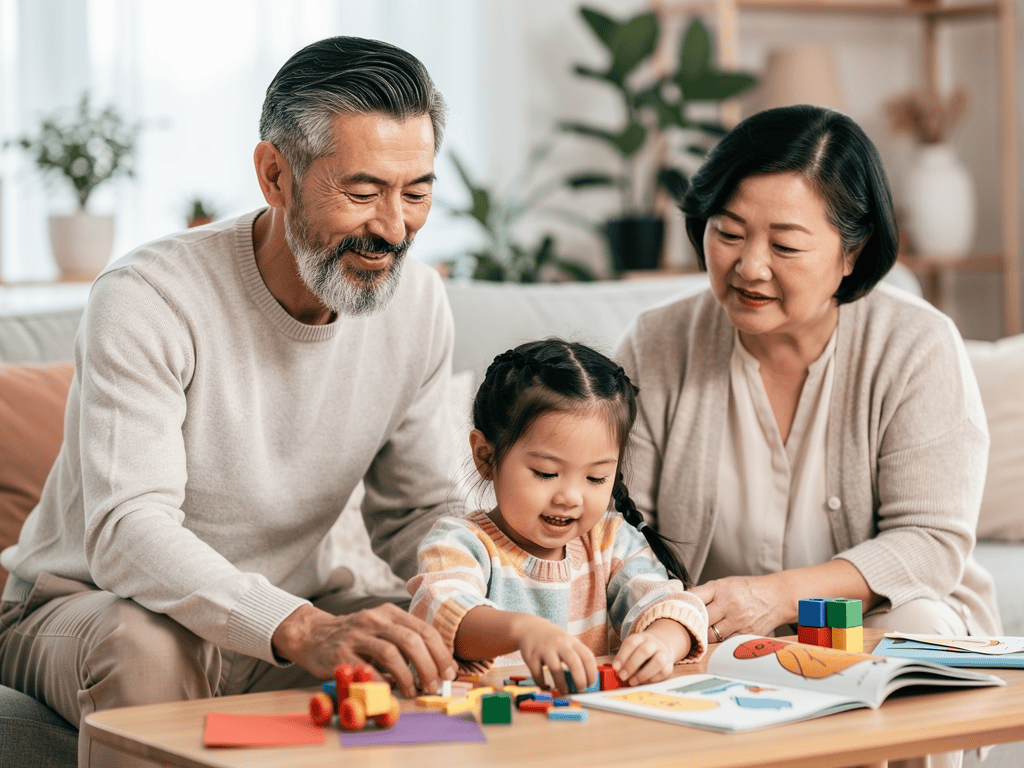
Even if a family member develops dementia, your role as grandparents remains important and valuable. Your grandchildren may need you even more now - as a stable reference person who gives them security and normality while other things in the family change. You can be a bridge between the past and the present by telling stories, sharing memories, and maintaining the connection to the family.
Your grandchildren benefit when you continue to spend regular time with them and engage in shared activities. These moments give your grandchildren the feeling that despite all changes, something constant remains. At the same time, you can help your grandchildren understand that it is okay to be sad or confused, and that the family works together to cope with the situation.
Providing stability for grandchildren
In times of change, stability is particularly important for children. As grandparents, you can provide this stability by continuing to spend regular time with your grandchildren and maintaining familiar routines. Perhaps you can set certain days or times that you spend together - whether playing, reading, walking, or simply talking.
These regular meetings give your grandchildren the feeling that there is something they can rely on, even if other things change. Show your grandchildren that your relationship with them is important and that you are there to support them. Your presence and attention help your grandchildren feel safe and loved, even in difficult times.
Communication with grandchildren
Open and honest communication is important so that your grandchildren can understand the situation. Adapt your explanations to the age of your grandchildren - younger children need simpler explanations, while older children and teenagers can understand more details. It is important that you are honest without overwhelming or frightening your grandchildren.
Encourage your grandchildren to ask questions and express their feelings. Listen to what they have to say and take their concerns seriously. Show that it is okay to be sad, angry, or confused, and that the family works together to cope with the situation. Your support and understanding help your grandchildren deal with their feelings and better understand the situation.
Providing practical support
As grandparents, you can provide practical support that helps both the affected family member and the other family members. Perhaps you can help with care, support with everyday tasks, or simply be there when someone needs you. Your support relieves the other family members and gives them the opportunity to recover and meet their own needs.
At the same time, you can help your grandchildren by showing them how to deal compassionately and patiently with the affected person. Your grandchildren learn important values such as empathy, patience, and willingness to help. These experiences shape your grandchildren and help them become compassionate and responsible people.
Designing shared activities
Shared activities can help create positive moments and strengthen the connection between family members. As grandparents, you can suggest and organize activities that are suitable for all involved. Perhaps you can walk together, play simple games, listen to music, or simply be together and talk.
It is important that the activities are adapted to the abilities of the affected person and that all involved feel comfortable. Your grandchildren can learn how to deal compassionately and patiently with people who need support. These experiences are valuable for your grandchildren's development and help them become compassionate people.
Dealing with changes
Dementia is a progressive disease, which means that the situation will change over time. As grandparents, you must learn to deal with these changes and adapt. This can be difficult, especially when you see how a loved one changes. But your ability to deal with changes is also an important role model for your grandchildren.
Your grandchildren observe how you deal with difficult situations and learn important lessons about resilience, patience, and adaptability. Show your grandchildren that it is okay to be sad or overwhelmed, but that the family works together to cope with the situation. Your strength and perseverance are important role models for your grandchildren.
Developing patience and understanding
Patience is one of the most important qualities you need when dealing with dementia in the family. The affected person may behave differently, forget things, or be confused. It is important to understand that this does not happen intentionally, but is part of the disease. Try to be patient and accept the person as they are, even if it is sometimes difficult.
Your grandchildren learn how important patience and understanding are, especially when it comes to people who need support. Show your grandchildren that it is okay to sometimes be frustrated, but that patience and understanding help cope with difficult situations. Your attitude shapes your grandchildren and helps them become compassionate and patient people.
Respecting your own boundaries
While it is important to help and support, it is also important to respect your own boundaries. You cannot handle everything alone, and it is okay to seek help or take breaks. Your own health and well-being are important so that you can continue to play an important role for your grandchildren.
Show your grandchildren that it is important to take care of yourself and seek help when you need it. Your grandchildren learn that self-care is not selfish, but necessary to be able to help others. This lesson is valuable for your grandchildren's entire life and helps them set healthy boundaries and take care of themselves.
Seeking professional help
Dementia is a complex disease that requires professional support. It is important to seek help early to ensure the best possible care for the affected person and relieve the family. As grandparents, you can help find the right contact points and accompany the family in seeking support.
Your grandchildren benefit when the family seeks professional help because this means that the affected person receives the best possible care and the other family members are relieved. Show your grandchildren that it is important to seek help when you need it, and that there is no shame in seeking support. This attitude helps your grandchildren also seek help in the future when they need it.
Counseling centers and contact points
There are various counseling centers and contact points that offer support for dementia. These include Alzheimer's societies, care support centers, counseling centers for relatives, and medical professionals. These places can provide information, counseling, and practical support.
As grandparents, you can help find the right contact points and establish contacts. Perhaps you can also accompany appointments or simply be there when someone needs support. Your help makes it easier for the family to find and use the necessary support.
Using respite services
Respite services such as day care, short-term care, or care services can help relieve the family and provide the best possible care for the affected person. These services give caring relatives the opportunity to recover and meet their own needs.
Your grandchildren benefit when the family uses respite services because this means that the other family members are less overwhelmed and have more time and energy for the grandchildren. Show your grandchildren that it is important to accept help and that the family works together to ensure the best possible care for everyone.
Self-care for grandparents
When dealing with dementia in the family, it is important to also take care of yourself. Your own health and well-being are important so that you can continue to play an important role for your grandchildren. Self-care is not selfish - it is necessary so that you can help others.
Your grandchildren need you as a healthy and stable reference person. When you take care of yourself, you can be better there for others. Show your grandchildren that self-care is important and that it is okay to take breaks or seek help when you need it. This lesson is valuable for your grandchildren's entire life.
Keeping your own health in mind
Pay attention to your own physical and mental health. Eat healthily, exercise regularly, and ensure adequate sleep. When you stay healthy, you can be better there for others and continue to play an important role for your grandchildren. Your health is important for your grandchildren so that they can spend a long time with you.
Perhaps you can also attend regular health checks and pay attention to warning signs. When you stay healthy, you can accompany and support your grandchildren for a long time. Show your grandchildren that health is important and that it is important to take care of yourself.
Building support networks
Build a support network - friends, family, self-help groups, or professional counselors. This network can help you deal with challenges and find support when you need it. You do not have to handle everything alone.
Your grandchildren benefit when you have a strong support network because this means that you can stay healthy and stable and continue to play an important role for them. Show your grandchildren that it is important to seek support and that the family works together to support everyone.
Creating positive moments
Despite all challenges, it is important to create and enjoy positive moments. As grandparents, you can help create these moments - whether through shared activities, conversations, memories, or simply through your presence. These positive moments are important for all family members and help maintain the connection between generations.
Your grandchildren need these positive moments to see that despite all challenges, life goes on and that there is still joy and connection. Show your grandchildren that it is important to enjoy the good moments and that the family works together to create positive experiences. This attitude helps your grandchildren find hope and joy even in difficult times.
Early signs of dementia
Support services for families
Self-care tips for grandparents
Tips for communicating with grandchildren
- Explain age-appropriately what dementia means
- Encourage your grandchildren to ask questions
- Listen and take feelings seriously
- Show that it is okay to be sad
- Emphasize that love remains
- Create space for conversations and questions
Shared activities with grandchildren
- Play simple games that everyone can understand
- Walk together and experience nature
- Listen to music or sing together
- Tell stories or read aloud
- Simple handicrafts or crafting
- Cook or bake together
Signs that you need help
- You constantly feel overwhelmed or exhausted
- Your own health is suffering
- You have no time left for your grandchildren
- You feel isolated or alone
- You have sleep problems or loss of appetite
- You feel sad or hopeless