



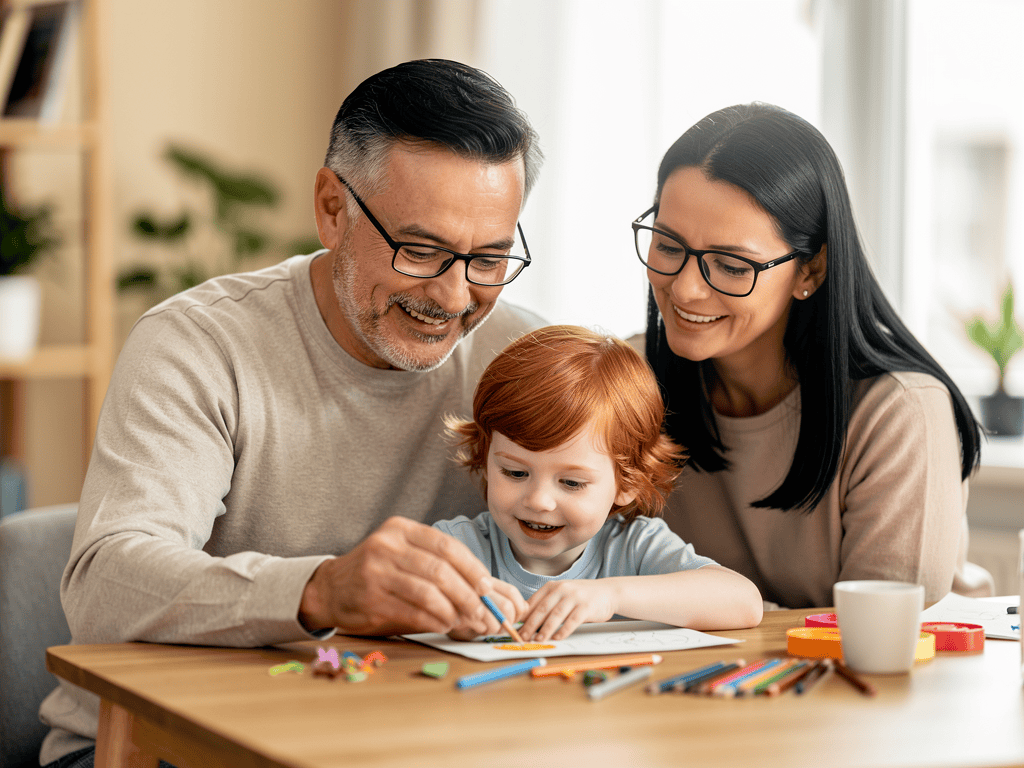
Why handicrafts are valuable for grandchildren
Handicrafts like knitting, crocheting and sewing are more than just creative hobbies – they are valuable activities that you can discover together with your grandchildren. These traditional skills not only offer the opportunity to create beautiful things, but also promote important abilities that will accompany your grandchildren throughout their lives. When you do handicrafts together with your grandchildren, you not only give them time and attention, but also valuable skills and memories.
As grandparents, you have the opportunity to pass on these special skills to your grandchildren and spend valuable time together. Handicrafts are activities that connect generations and allow you to pass on your experiences and knowledge. When you knit, crochet or sew together with your grandchildren, you not only create beautiful things, but also a deep connection that goes beyond the shared activity.
Your grandchildren will benefit from these shared hours, not only through the skills learned, but also through the time you spend together. Handicrafts are activities that promote calm and concentration and allow you to talk quietly and get to know each other. These shared experiences will shape your grandchildren and help them develop valuable skills they can use throughout their lives.
Promoting fine motor skills
Handicrafts like knitting, crocheting and sewing promote your grandchildren's fine motor skills in a playful way. When knitting, the fingers must work precisely to form stitches and guide threads. When crocheting, hand-eye coordination and finger dexterity are trained. When sewing, children learn to perform precise movements and work with needle and thread. These skills are not only important for handicrafts, but also for many other activities in life.
The development of fine motor skills is particularly important at a young age, as it forms the basis for many other skills. When you do handicrafts together with your grandchildren, you support this development in a natural and playful way. Your grandchildren will not only learn how to knit, crochet or sew, but also improve their finger dexterity and coordination, which will help them in many areas of life.
Especially for younger children, handicrafts are a wonderful way to train fine motor skills without it seeming like an exercise. The joy of creating and the opportunity to make something of their own motivates children to concentrate and improve their skills. As grandparents, you can support this development and spend valuable time together.
Developing patience and concentration
Handicrafts require patience and concentration – skills that are becoming increasingly important in our fast-paced world. When you knit, crochet or sew together with your grandchildren, you help them develop these valuable qualities. Your grandchildren learn that some things take time and that it is worth being patient and staying with the task.
The ability to concentrate and be patient is not only important for handicrafts, but also for many other areas of life. When your grandchildren learn to concentrate on an activity and be patient, they develop important skills that will help them in school, at work and in everyday life. As grandparents, you can support this development by doing handicrafts together with your grandchildren and showing them how valuable patience and concentration are.
Handicrafts also offer the opportunity to calm down and forget everyday life for a moment. In a world that is often hectic and overwhelming, handicrafts can be an oasis of calm. When you do handicrafts together with your grandchildren, you create a space where time doesn't matter and where you can focus entirely on the shared activity. These moments of calm and concentration are valuable for you and your grandchildren.
Strengthening the bond
Shared handicraft sessions are a wonderful way to strengthen the bond between you and your grandchildren. When you knit, crochet or sew together, you not only spend time together, but also share a common activity that enables conversations and exchange. In these quiet moments, you can get to know each other better and build a deeper connection.
Handicrafts offer the opportunity to talk quietly with each other without it seeming like a formal conversation. While you work together, you can talk about anything – about school, about hobbies, about dreams and wishes. These conversations arise naturally and casually, which makes them particularly valuable. As grandparents, you can use these moments to get to know your grandchildren better and listen to them.
The shared successes in handicrafts also strengthen the bond between you and your grandchildren. When you complete a project together, you can be proud of what you have created. These shared successes create positive memories and strengthen the feeling of being a team. Your grandchildren will appreciate these shared hours and fondly remember them when they are older.
First steps: Materials and basic equipment
Before you start doing handicrafts together with your grandchildren, it is important to have the right basic equipment. The materials don't have to be expensive, but they should be of good quality so that working is enjoyable and the results are beautiful. As grandparents, you can use your experience to select the right materials and show your grandchildren what matters.
For getting started, a simple basic equipment is sufficient, which you can gradually expand. It is important that the materials are age-appropriate and that your grandchildren can work well with them. When you go shopping together to get the materials, you can also show your grandchildren how to recognize good quality and what to look for. These shared shopping trips are also a good opportunity to look forward to the shared handicraft sessions.
The right basic equipment makes getting started with handicrafts easier and more pleasant. When your grandchildren can work with good materials, they will have more fun with handicrafts and make faster progress. As grandparents, you can use your experience to select the right materials and help your grandchildren get off to a good start.
Basic equipment for knitting
To get started with knitting, you need knitting needles in various sizes and wool or yarn. For beginners, thicker needles and thicker wool are suitable, as these are easier to handle. Recommended are knitting needles in sizes 4 to 6 and medium-thick wool. The needles should be made of wood or plastic, as these feel more comfortable in the hand than metal needles.
It is also important that the wool is soft and pleasant to work with. Acrylic wool or mixed wool are particularly suitable for beginners, as they are easy to care for and inexpensive. When you go shopping together with your grandchildren, you can feel different types of wool and decide together which feels best. This shared decision makes getting started even more beautiful.
In addition to needles and wool, you also need scissors to cut the threads and possibly a darning needle to weave in the ends. For the beginning, this simple equipment is completely sufficient. When your grandchildren make progress, you can gradually expand the equipment and try new techniques and materials.
Basic equipment for crocheting
To get started with crocheting, you need crochet hooks in various sizes and crochet yarn. Similar to knitting, thicker needles and thicker yarn are suitable for beginners. Recommended are crochet hooks in sizes 4 to 6 and medium-thick crochet yarn. The needles should be made of wood or plastic, as these feel more comfortable in the hand.
Crochet yarn comes in many different colors and materials. Acrylic yarn or cotton yarn are particularly suitable for beginners, as they are easy to work with and produce beautiful results. When you go shopping together with your grandchildren, you can choose different yarns and decide together which colors and materials are most beautiful.
In addition to needles and yarn, you also need scissors and possibly a darning needle. For the beginning, this simple equipment is completely sufficient. When your grandchildren make progress, you can expand the equipment and try new techniques such as amigurumi or filet crocheting.
Basic equipment for sewing
To get started with sewing, you need needle and thread, fabric and possibly a sewing machine for older children. Large, blunt needles and thick thread are particularly suitable for beginners, as these are easier to handle. Recommended are sewing needles in various sizes and colorful threads that are clearly visible on the fabric.
Simple fabrics such as cotton or felt are suitable for first sewing projects, as they are easy to work with and do not fray. When you go shopping together with your grandchildren, you can feel different fabrics and decide together which are best for the first projects. This shared decision makes getting started even more beautiful.
In addition to needle, thread and fabric, you also need scissors, pins and possibly a measuring tape. For the beginning, this simple equipment is completely sufficient. When your grandchildren make progress, you can expand the equipment and try new techniques such as sewing with a sewing machine.
Age-appropriate projects for grandchildren
It is important that the projects you do together with your grandchildren are age-appropriate. Younger children need simpler projects with fewer steps, while older children can handle more complex projects. As grandparents, you can use your experience to select the right projects for your grandchildren and support them in gradually developing their skills.
For getting started, the projects should be simple and quick to realize so that your grandchildren have quick success experiences. When the first projects are successful, your grandchildren will be motivated to continue and tackle more complex projects. As grandparents, you can accompany this development and support your grandchildren in expanding their skills.
The selection of the right projects is crucial for the success of the shared handicraft sessions. If the projects are too difficult, your grandchildren will be frustrated. If they are too simple, they will quickly become boring. As grandparents, you can find the balance and select projects that challenge your grandchildren but do not overwhelm them.
Projects for preschoolers
For preschoolers, simple projects that are quick to realize and do not require complex techniques are particularly suitable. When knitting, you can start with simple stitches and knit a small scarf or small blanket together. When crocheting, you can crochet simple squares that can later be sewn together into a blanket. When sewing, you can sew simple stuffed animals or small pillows.
It is important that you give a lot of support to younger children and that the projects are divided into small steps. Your grandchildren should feel that they are creating something themselves, even if you help. Let your grandchildren do as much as possible themselves, but be there when help is needed. This balance between independence and support is important for the development of your grandchildren.
For preschoolers, projects that they can use themselves are also nice, such as a self-knitted scarf or a self-sewn stuffed animal. When your grandchildren see that they have created something useful or beautiful, they will be proud and motivated to continue. As grandparents, you can celebrate these successes with your grandchildren and show them how valuable their work is.
Projects for elementary school children
Elementary school children can already handle more complex projects and have more patience for longer projects. When knitting, you can knit hats, gloves or small sweaters together. When crocheting, you can crochet amigurumi animals, bags or blankets. When sewing, you can sew clothing, bags or pillows.
It is important that you divide the projects into manageable steps for elementary school children and that you take regular breaks. Your grandchildren should feel that they are making progress, even if the project is not finished yet. Let your grandchildren do as much as possible themselves, but be there when help is needed or when something doesn't work.
For elementary school children, projects that they can give away are also nice, such as self-knitted hats for the family or self-sewn bags for friends. When your grandchildren see that other people are happy about their handicrafts, they will be proud and motivated to continue. As grandparents, you can celebrate these successes with your grandchildren and show them how valuable their work is.
Projects for older children
Older children can already handle very complex projects and have the patience and concentration for longer projects. When knitting, you can knit sweaters, cardigans or complex patterns together. When crocheting, you can crochet large blankets, clothing or complex amigurumi projects. When sewing, you can sew clothing, bags or even quilts.
It is important that you choose projects for older children that are challenging but not overwhelming. Your grandchildren should feel that they are creating something special, but also that they have the skills to handle the project. Let your grandchildren do as much as possible themselves, but be there when help is needed or when something doesn't work.
For older children, projects that they can design themselves are also nice, such as self-knitted sweaters in their favorite colors or self-sewn bags with their own designs. When your grandchildren can realize their own ideas, they will be proud and motivated to continue. As grandparents, you can support this creativity and help your grandchildren realize their own projects.
Learning to knit together
Knitting is a wonderful handicraft technique that you can discover together with your grandchildren. When knitting, stitches are formed that are joined together into a fabric. The basic technique is relatively easy to learn, but there are many different patterns and techniques that you can gradually discover. When you learn to knit together with your grandchildren, you can pass on your experience and spend valuable time together.
Getting started with knitting begins with the basic stitches – the knit stitch and the purl stitch. These two stitches are the basis for all knitting projects. When your grandchildren master these basic stitches, you can knit simple projects together such as scarves, hats or small blankets. Over time, you can then try more complex patterns and techniques.
When learning to knit, it is important that you are patient and that you encourage your grandchildren, even if it is difficult at first. Knitting requires practice, and it is normal that not everything is perfect at first. When you practice together and see mistakes as part of the learning process, your grandchildren will make faster progress and have more fun knitting.
The first stitches
Getting started with knitting begins with casting on the first stitches. Show your grandchildren how to cast on stitches and let them try it themselves. At first, it may not be perfect, but that is completely normal. It is important that your grandchildren feel that they can do it themselves, even if you help.
After casting on come the basic stitches – the knit stitch and the purl stitch. Show your grandchildren how to knit these stitches and let them try it themselves. At first, it may be slow, but over time your grandchildren will become faster and more confident. Let your grandchildren work at their own pace and be patient when it doesn't work immediately.
When your grandchildren master the basic stitches, you can start simple projects together. A simple scarf is a good first project, as it only requires knit stitches and is relatively quick to realize. When the first scarf is finished, your grandchildren will be proud and motivated to tackle more projects.
Simple projects for beginners
For beginners, simple projects that are quick to realize and do not require complex techniques are particularly suitable. A simple scarf is a good first project, as it only requires knit stitches and is relatively quick to realize. When the first scarf is finished, your grandchildren will be proud and motivated to tackle more projects.
Other simple projects for beginners are small blankets, hats or gloves. These projects require a bit more skill, but they are still manageable for beginners. When you realize these projects together with your grandchildren, you can pass on your experience and spend valuable time together.
It is important that you choose the projects so that they are age-appropriate and that your grandchildren feel that they can handle them. If the projects are too difficult, your grandchildren will be frustrated. If they are too simple, they will quickly become boring. As grandparents, you can find the balance and select projects that challenge your grandchildren but do not overwhelm them.
Patience and mistakes as part of learning
When learning to knit, it is normal that mistakes happen. Stitches can slip, threads can tangle, or the project may not look as it should. It is important that you see these mistakes as part of the learning process and that you show your grandchildren how to deal with mistakes. When you correct mistakes together, your grandchildren learn that mistakes are not bad and that you can learn from them.
Patience is very important when learning to knit. Your grandchildren will not be able to knit perfectly immediately, and that is completely normal. Let your grandchildren work at their own pace and be patient when it doesn't work immediately. When you are patient and encourage your grandchildren, they will make faster progress and have more fun knitting.
When your grandchildren are frustrated because something doesn't work, take time to solve the problem together. Show your grandchildren how to correct mistakes and encourage them to continue. When you solve problems together, your grandchildren learn that you can also learn something from difficult situations and that it is worth not giving up.
Discovering crocheting with grandchildren
Crocheting is another wonderful handicraft technique that you can discover together with your grandchildren. When crocheting, you work with a crochet hook that forms stitches that are joined together into a fabric. Crocheting is often a bit easier to learn than knitting, as you only need one needle and the stitches are easier to see. When you learn to crochet together with your grandchildren, you can pass on your experience and spend valuable time together.
Getting started with crocheting begins with the basic stitches – the chain stitch, the single crochet and the double crochet. These three stitches are the basis for all crocheting projects. When your grandchildren master these basic stitches, you can crochet simple projects together such as squares, circles or small animals. Over time, you can then try more complex patterns and techniques.
Crocheting offers many creative possibilities, from simple blankets to complex amigurumi figures. When you crochet together with your grandchildren, you can try various projects and express your creativity. The variety of crocheting projects makes crocheting an exciting and varied handicraft technique.
Basic crocheting techniques
Getting started with crocheting begins with the chain stitch, which is the basis for all crocheting projects. Show your grandchildren how to crochet chain stitches and let them try it themselves. At first, it may not be perfect, but that is completely normal. It is important that your grandchildren feel that they can do it themselves, even if you help.
After the chain stitch come the single crochet and the double crochet. Show your grandchildren how to crochet these stitches and let them try it themselves. At first, it may be slow, but over time your grandchildren will become faster and more confident. Let your grandchildren work at their own pace and be patient when it doesn't work immediately.
When your grandchildren master the basic stitches, you can start simple projects together. A simple square is a good first project, as it only requires single crochets and is relatively quick to realize. When the first square is finished, you can crochet several squares and sew them together into a blanket.
Creative crocheting projects
Crocheting offers many creative possibilities, from simple blankets to complex amigurumi figures. When you crochet together with your grandchildren, you can try various projects and express your creativity. Simple projects for beginners are squares, circles or small animals that can later be sewn together into a blanket.
For advanced crocheters, more complex projects such as large blankets, bags or amigurumi figures are suitable. These projects require more skill and patience, but they also offer the opportunity to create really special things. When you realize these projects together with your grandchildren, you can pass on your experience and spend valuable time together.
The variety of crocheting projects makes crocheting an exciting and varied handicraft technique. When you try various projects together with your grandchildren, you can express your creativity and create valuable shared memories. These shared projects will shape your grandchildren and help them develop their skills.
Sewing as a shared experience
Sewing is another wonderful handicraft technique that you can discover together with your grandchildren. When sewing, fabrics are sewn together with needle and thread to make various things. Sewing requires a bit more skill than knitting or crocheting, but it also offers many creative possibilities. When you learn to sew together with your grandchildren, you can pass on your experience and spend valuable time together.
Getting started with sewing begins with simple hand sewing techniques. Show your grandchildren how to work with needle and thread and let them try it themselves. At first, it may not be perfect, but that is completely normal. It is important that your grandchildren feel that they can do it themselves, even if you help.
For older children, sewing with a sewing machine can also be interesting. Sewing with a sewing machine requires more skill and concentration, but it also allows you to realize larger projects faster. When you sew together with your grandchildren, you can try various techniques and express your creativity.
Safe sewing techniques for children
When sewing with children, safety is very important. Use large, blunt needles for younger children and show your grandchildren how to work safely with needle and thread. It is important that your grandchildren learn to be careful and that they know how to hold and guide the needle correctly. When you sew together, you can support your grandchildren in working safely.
For older children, sewing with a sewing machine can also be interesting, but special care is required here. Show your grandchildren how to operate the sewing machine safely and stay with them when they sew. It is important that your grandchildren learn to be careful and that they know how to operate the sewing machine correctly. When you sew together, you can support your grandchildren in working safely.
It is also important that you set up a safe workspace where your grandchildren can work undisturbed. The workspace should be well lit and offer enough space so that your grandchildren can work comfortably. When you sew together, you can support your grandchildren in working safely and concentrated.
Simple sewing projects
For beginners, simple sewing projects that are quick to realize and do not require complex techniques are particularly suitable. Simple projects for beginners are small pillows, stuffed animals or small bags. These projects only require simple hand sewing techniques and are relatively quick to realize.
When your grandchildren make progress, you can tackle more complex projects, such as clothing, larger bags or quilts. These projects require more skill and patience, but they also offer the opportunity to create really special things. When you realize these projects together with your grandchildren, you can pass on your experience and spend valuable time together.
The variety of sewing projects makes sewing an exciting and varied handicraft technique. When you try various projects together with your grandchildren, you can express your creativity and create valuable shared memories. These shared projects will shape your grandchildren and help them develop their skills.
Tips for successful handicraft sessions
For the shared handicraft sessions with your grandchildren to be successful, there are some things you can pay attention to. It is important that you create a quiet and relaxed atmosphere where your grandchildren feel comfortable and can work concentrated. When you do handicrafts together, you should also be patient and encourage your grandchildren, even if it is difficult at first.
The shared handicraft sessions should not seem like a duty, but like a beautiful shared activity. When you do handicrafts together, you can talk quietly with each other and get to know each other better. These shared moments are valuable for you and your grandchildren and create positive memories that will last a long time.
It is also important that you celebrate the successes of your grandchildren, even if they are still small. When your grandchildren see that you are proud of their work, they will be motivated to continue. The shared successes in handicrafts also strengthen the bond between you and your grandchildren and create positive memories.
Creating the right atmosphere
A quiet and relaxed atmosphere is important for successful handicraft sessions. Create a space where your grandchildren feel comfortable and can work concentrated. The room should be well lit and offer enough space so that your grandchildren can work comfortably. When you do handicrafts together, you can also play quiet music in the background to create a relaxed atmosphere.
It is also important that you plan enough time so that your grandchildren don't have to rush. Handicrafts take time, and it is important that your grandchildren can work at their own pace. When you do handicrafts together, you should also take regular breaks so that your grandchildren can recover and are not overwhelmed.
The shared handicraft sessions should not seem like a duty, but like a beautiful shared activity. When you do handicrafts together, you can talk quietly with each other and get to know each other better. These shared moments are valuable for you and your grandchildren and create positive memories that will last a long time.
Patience and encouragement
Patience is very important when learning handicrafts. Your grandchildren will not be able to knit, crochet or sew perfectly immediately, and that is completely normal. Let your grandchildren work at their own pace and be patient when it doesn't work immediately. When you are patient and encourage your grandchildren, they will make faster progress and have more fun with handicrafts.
Encouragement is also important, especially when your grandchildren are frustrated because something doesn't work. Show your grandchildren that mistakes are not bad and that you can learn from them. When you correct mistakes together, your grandchildren learn that mistakes are part of the learning process and that it is worth not giving up.
It is also important that you recognize and praise the small progress of your grandchildren. When your grandchildren see that you are proud of their work, they will be motivated to continue. The shared successes in handicrafts also strengthen the bond between you and your grandchildren and create positive memories.
Celebrating shared successes
It is important that you celebrate the successes of your grandchildren, even if they are still small. When your grandchildren see that you are proud of their work, they will be motivated to continue. The shared successes in handicrafts also strengthen the bond between you and your grandchildren and create positive memories.
When a project is finished, you can admire it together and take photos. Also show the finished projects to other family members or friends so that your grandchildren see that their work is appreciated. This recognition is important for the motivation of your grandchildren and strengthens their self-confidence.
The shared successes in handicrafts are also a good opportunity to reflect together on what you have learned and what you would like to try next. When you talk about the projects together, you can support your grandchildren in developing their skills and tackling new challenges. These shared conversations are valuable for you and your grandchildren.
Basic equipment for handicrafts
Age-appropriate projects for handicrafts
Typical learning progress in handicrafts
Tips for material selection
- Choose materials of good quality that are pleasant to work with
- For beginners, thicker needles and thicker wool or yarn are suitable
- Let your grandchildren participate in material selection
- Start with simple materials and gradually expand
- Pay attention to safety, especially with needles and scissors
Tips for project selection
- Choose projects that are age-appropriate and challenge your grandchildren but do not overwhelm them
- Start with simple projects that are quick to realize
- Let your grandchildren participate in project selection
- Divide larger projects into small steps
- Celebrate the successes, even if they are still small
Tips for successful learning
- Be patient and encourage your grandchildren, even if it is difficult at first
- Let your grandchildren work at their own pace
- See mistakes as part of the learning process
- Celebrate the small progress and successes
- Create a quiet and relaxed atmosphere