



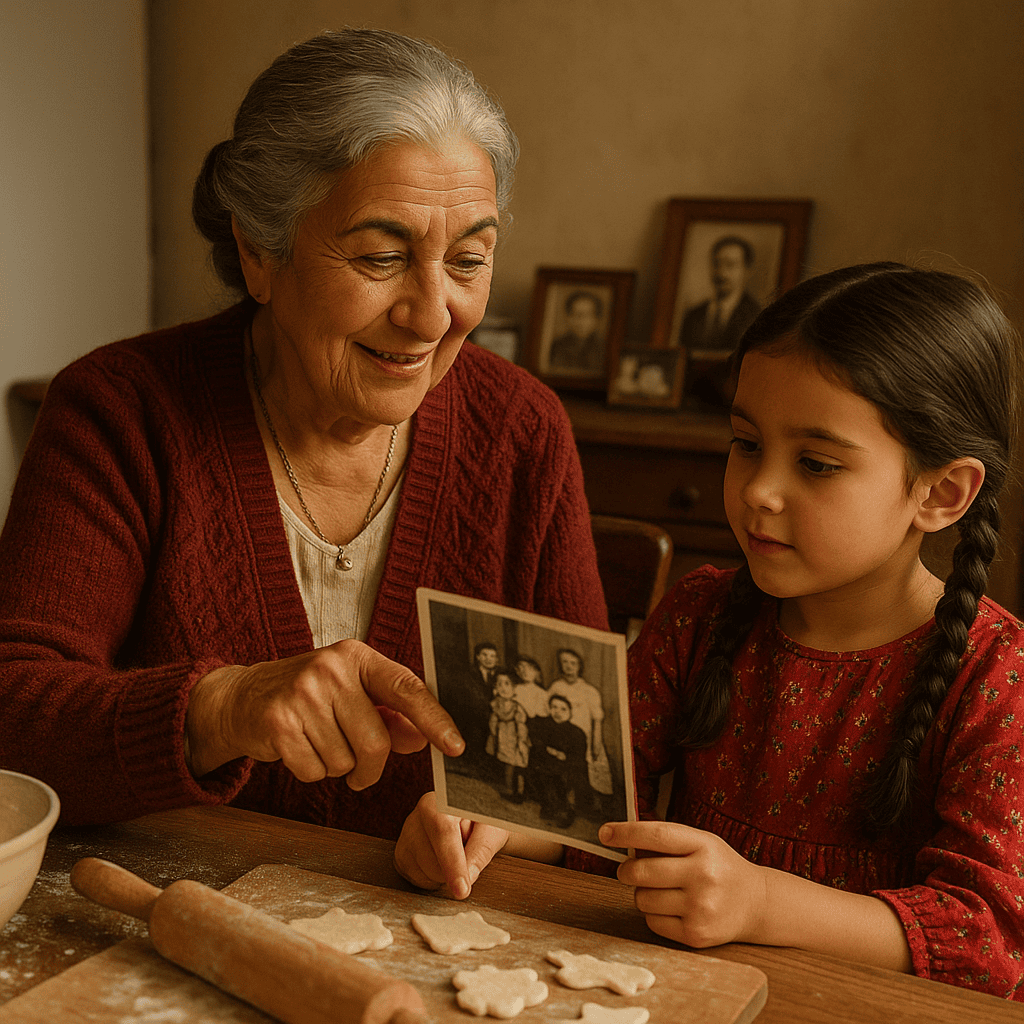
Why Traditions and Family History Matter
Traditions and family history are more than just beautiful memories – they give your grandchildren a sense of identity, belonging and roots. When your grandchildren know where they come from and what values shape their family, it helps them understand themselves better and find their place in the world. As grandparents, you can create this important connection between past and future so your grandchildren can know and appreciate their family history.
Your grandchildren will grow up in a fast-paced world where traditions sometimes take a back seat. When you show them which traditions and stories have shaped your family, you give them something valuable: a sense of continuity, stability and connection. This connection to family history can help your grandchildren find support even in difficult times and know that they are part of something bigger.
Traditions and family history are also a way to convey values without being preachy. When you tell stories about how your family dealt with challenges, what values were important and how traditions came about, your grandchildren naturally learn what matters in life. These lessons will accompany your grandchildren throughout their lives and help them become responsible and value-oriented people.
Identity and Roots
When your grandchildren know their family history, it helps them develop their own identity. They learn where they come from, what people shaped their family and what stories their ancestors told. This knowledge of their roots gives your grandchildren a sense of belonging and helps them understand who they are and where they come from.
Family history also shows your grandchildren that they are part of a larger story. They learn that their family has grown over generations, that there have been ups and downs and that their ancestors have mastered challenges. This perspective can help your grandchildren master their own challenges and know that they stand on solid ground.
When you show your grandchildren their roots, you also give them something they can pass on to their own grandchildren. Family history becomes a living bond that connects generations. Your grandchildren will learn to appreciate these stories and traditions and may want to pass them on to their own grandchildren one day. This creates a connection that lasts across generations.
Values and Orientation
Traditions and family history are a wonderful way to convey values without being preachy. When you tell stories about how your family dealt with certain situations, what decisions were made and why certain values were important, your grandchildren naturally learn what matters in life.
These values can also give your grandchildren guidance when they face decisions themselves. When they know what values shaped their family and how their ancestors dealt with similar situations, they can use this as a guide. Family history becomes a source of wisdom that your grandchildren can draw on.
It is important that you tell not only the positive stories but also the challenges and difficulties. When your grandchildren see how their ancestors dealt with problems, they learn that challenges are part of life and can be mastered. These lessons are more valuable than any lecture and help your grandchildren become resilient and confident.
Living Traditions in Everyday Life
Traditions don't have to be grand or elaborate – often it's the small, regular rituals that mean the most. When you live traditions in everyday life, you show your grandchildren that traditions are something living that can be part of daily life. These regular moments create connection and give your grandchildren something to look forward to.
You can also adapt traditions to your grandchildren's needs. Perhaps there are certain traditions from your own childhood that you want to continue, or you can create new traditions together with your grandchildren. What matters is that the traditions are meaningful to you and your grandchildren and that they are lived regularly.
When you live traditions in everyday life, you also show your grandchildren that traditions don't have to be rigid but can evolve. Perhaps you combine old traditions with new ideas or adapt them to today's times. This flexibility shows your grandchildren that traditions are alive and that they themselves can be part of this development.
Celebrations and Festivals
Celebrations and festivals are a wonderful way to live traditions and convey family history. Whether Christmas, birthdays, Easter or other family celebrations – these occasions offer the opportunity to tell stories, maintain old customs and spend time together. When you celebrate these festivals with your grandchildren, you create memories that will accompany them throughout their lives.
You can also create new traditions for festivals that are special to your family. Perhaps there is a particular dish that is always cooked for a certain festival, or a ritual that is repeated every year. These special moments become a fixed part of family history and give your grandchildren something to look forward to.
It is important that you involve your grandchildren in the preparation and execution of the festivals. When they are part of the traditions themselves, they will appreciate them more and may want to continue them themselves one day. Let your grandchildren help decide which traditions are important and how they should be celebrated. This makes the traditions something that truly belongs to the whole family.
Rituals and Habits
Not only big festivals, but also small rituals in everyday life can be traditions. Perhaps there is a particular way you eat together, a particular story you always tell, or an activity you regularly do together. These small rituals create connection and give your grandchildren a sense of stability and security.
Rituals can also be connected to family history. Perhaps there is a particular song that has been sung in your family for generations, or a particular way you do certain things that comes from your ancestors. When you share these rituals with your grandchildren and explain where they come from, you connect the past with the present.
You can also create new rituals that are special to you and your grandchildren. Perhaps there is a particular time of day or week that you spend together, or a particular activity you regularly do together. These rituals become a fixed part of your relationship and give your grandchildren something to look forward to. When you maintain these rituals, you show your grandchildren that they are important and that the time you spend together is valuable.
Telling Family History
Telling stories is one of the oldest and most effective ways to pass on family history. When you tell your grandchildren stories from your own childhood, about your parents or about other family members, you bring the past to life. These stories become part of your grandchildren's identity and help them understand where they come from.
Stories don't have to be perfect or dramatic – often it's the small, everyday stories that mean the most. Tell about moments that were important to you, about people who shaped you, or about experiences you had. Your grandchildren will love these stories because they come from you and because they help them understand you better.
When you tell stories, you can also convey values and life wisdom without being preachy. When you tell how your family dealt with challenges, what decisions were made and why certain values were important, your grandchildren naturally learn what matters in life. These lessons will accompany your grandchildren throughout their lives.
Stories from Your Own Childhood
Stories from your own childhood are particularly valuable for your grandchildren because they show them how you grew up and what experiences shaped you. Tell about moments that were important to you: about games you played, friends you had, or experiences you will never forget. These stories help your grandchildren understand you better and feel a connection to your past.
You can also tell stories that show how times have changed. Perhaps there were things you did as a child that are different today, or experiences you had that your grandchildren will no longer have. These stories show your grandchildren how the world has evolved and help them understand their own time better.
It is important that you also tell stories that show that life was not always easy. When you tell about challenges you mastered or moments when you needed help, you show your grandchildren that adults sometimes have difficulties too and that it's okay to ask for help. These stories make you human and help your grandchildren master their own challenges better.
Stories About Ancestors
Stories about your ancestors – your parents, grandparents or other family members – help your grandchildren understand where they come from and what people shaped their family. Tell about people you knew, their stories and the values they represented. These stories connect your grandchildren with their family history and give them a sense of continuity.
When you tell stories about ancestors, you can also show how the family has evolved over generations. Perhaps there are certain professions that were passed down in the family, certain values that were important, or certain traditions that were maintained. These stories show your grandchildren that they are part of a larger story and that their family has grown over generations.
You can also tell stories that show how your ancestors dealt with challenges. Perhaps there were difficult times that were mastered, or important decisions that were made. These stories show your grandchildren that challenges are part of life and can be mastered. They also give your grandchildren a sense of strength and resilience that will help them master their own challenges.
Documenting Family History
In addition to telling stories, you can also document family history so it is preserved for the future. Photo albums, mementos, family trees or written records help your grandchildren understand and appreciate family history. When you go through these documents together with your grandchildren, you create moments of connection and shared remembrance.
Documentation doesn't have to be perfect or professional – what matters is that memories and stories are recorded. Perhaps you can create a memory book together with your grandchildren that collects stories, photos and mementos. Or you can create a family tree that shows how the family is connected. These projects will become a valuable treasure for your grandchildren and for future generations.
When you document family history, you can also show how the family has evolved. Perhaps there are photos from different generations that show how the family has changed, or documents that record important events. These documents help your grandchildren understand that their family has a history and that they are part of this history.
Photo Albums and Mementos
Photo albums are a wonderful way to preserve and share family history. When you browse through photo albums together with your grandchildren, you can tell stories about the pictures and explain who the people are and what is happening in the photos. These moments create connection and help your grandchildren understand their family better.
Mementos – whether letters, postcards, certificates or other items – can also tell stories. When you look at these items together with your grandchildren and explain where they come from and what they mean, you bring the past to life. These mementos become a tangible part of family history that your grandchildren can touch and experience.
You can also collect new mementos together with your grandchildren. Perhaps there are certain places you visit together, or activities you do together that become mementos. When you collect and preserve these items, you create a collection of memories that will accompany your grandchildren throughout their lives.
Family Tree and Family Chart
A family tree or family chart visually shows how the family is connected and how the generations have evolved. When you create a family tree together with your grandchildren, you can tell stories about the different family members and explain how the family has grown. This visual representation helps your grandchildren understand family history better.
You can also design a family tree creatively – perhaps with photos, drawings or other elements that represent the different family members. When your grandchildren work on the family tree themselves, they will understand family history better and feel more connected to it. This family tree will become a valuable document that you created together.
A family tree can also show how the family has evolved over time. Perhaps there are certain professions that were passed down in the family, certain places where the family lived, or certain traditions that were maintained. This information helps your grandchildren understand that their family has a history and that they are part of this history.
Joint Projects with Grandchildren
Joint projects where you and your grandchildren document family history or create traditions can be a wonderful way to spend time together while creating something valuable. When you create a memory book together, compile a family tree or write down family history, you create not only documents but also memories that will accompany your grandchildren throughout their lives.
Such projects also give your grandchildren the opportunity to become active themselves and contribute their own ideas. When you let your grandchildren help decide how the project should be designed, which stories are important and how the documentation should look, you show them that their opinion matters and that they are part of family history. This participation makes the projects something special that truly belongs to the whole family.
Joint projects can also help strengthen the relationship between you and your grandchildren. When you work together on something, you create positive memories and show your grandchildren that you are a team. These shared experiences will shape your grandchildren and help them see family history as something positive and important that is worth preserving.
Creating a Memory Book
A memory book is a wonderful way to collect and preserve family history. You can create a book together with your grandchildren that collects stories, photos, mementos and other important things. This book will become a valuable treasure that your grandchildren will keep throughout their lives.
When creating the memory book, you can actively involve your grandchildren. Let them decide which stories are important, which photos should be included and how the book should be designed. When your grandchildren work on the book themselves, they will appreciate it more and may want to continue it themselves one day. This joint project becomes a fixed part of your relationship.
A memory book can also grow over time. Perhaps you keep adding new stories, photos or mementos when new things happen or when you remember new stories. This makes the book a living document that continuously expands family history and shows how the family has evolved.
Writing Down Family History
When you write down family history, you create a permanent document that is preserved for future generations. You can write down stories from your own childhood, about your ancestors or about important events. These written records will become a valuable treasure for your grandchildren and for future generations.
You don't have to be a professional writer to write down family history – what matters is that the stories are recorded. Simply write down what is important to you, in your own words and in your own style. Your grandchildren will appreciate these stories because they come from you and because they help them understand their family history.
You can also write down family history together with your grandchildren. Perhaps you tell stories while your grandchildren write them down, or you work together on a text. This joint work creates connection and gives your grandchildren the opportunity to be part of the documentation themselves. This makes family history something you created together.
Passing on Values and Life Wisdom
Traditions and family history are a wonderful way to convey values and life wisdom without being preachy. When you tell stories that show what values were important in your family, how challenges were dealt with and what decisions were made, your grandchildren naturally learn what matters in life.
These values can also give your grandchildren guidance when they face decisions themselves. When they know what values shaped their family and how their ancestors dealt with similar situations, they can use this as a guide. Family history becomes a source of wisdom that your grandchildren can draw on.
It is important that you tell not only the positive stories but also the challenges and difficulties. When your grandchildren see how their ancestors dealt with problems, they learn that challenges are part of life and can be mastered. These lessons are more valuable than any lecture and help your grandchildren become resilient and confident.
Sharing Important Life Experiences
Your life experiences are a valuable treasure that you can pass on to your grandchildren. When you tell about important moments in your life, decisions you made or experiences you had, you give your grandchildren insights that will help them make their own decisions.
You can also tell about mistakes you made and what you learned from them. When your grandchildren see that adults also make mistakes and learn from them, it helps them become more confident and know that mistakes are part of life. These stories make you human and help your grandchildren accept their own mistakes and learn from them.
It is important that you don't present your experiences as a lecture but as stories that your grandchildren can interpret themselves. When you tell what was important to you and why, you give your grandchildren the opportunity to draw their own conclusions. This way of passing on knowledge is more valuable than any direct lecture.
Conveying Values Through Stories
Stories are a wonderful way to convey values without being preachy. When you tell stories that show how your family lived certain values – such as helpfulness, honesty, respect or responsibility – your grandchildren naturally learn what matters in life.
You can also tell stories that show how values were important in different situations. Perhaps there is a story about how your family helped someone who needed help, or a story about how a difficult decision was made because certain values were important. These stories show your grandchildren that values are not just abstract concepts but are important in daily life.
It is important that you also tell stories that show that values are sometimes difficult to live. When you tell how you or your ancestors sometimes had difficulty living certain values, or how you sometimes made mistakes, you show your grandchildren that values are something you have to practice again and again. These stories make values tangible and help your grandchildren understand that adults are sometimes uncertain too, but still try to do the right thing.
Using Modern Possibilities
Today there are many modern ways to preserve and share traditions and family history. You can create digital photo albums, record videos where you tell stories, or use online family trees. These modern methods can be particularly interesting for younger grandchildren and help make family history accessible to the digital generation as well.
You can also create digital projects together with your grandchildren. Perhaps you can create a video together where you tell stories, or a digital presentation that shows family history. These projects give your grandchildren the opportunity to contribute their technical skills while creating something valuable.
It is important that you don't see modern possibilities as a replacement for personal conversations but as a supplement. The personal connection that arises when you tell stories together or look at mementos cannot be replaced by digital methods. But digital methods can help preserve family history for the future and share it with others.
Different Categories of Traditions
Methods for Documenting Family History
Values That Can Be Conveyed Through Stories
Tips for Passing on Traditions
- Live traditions regularly in everyday life, not just on special occasions
- Actively involve your grandchildren in traditions, let them help decide
- Tell stories about traditions, explain where they come from
- Adapt traditions to your grandchildren's needs, they don't have to be rigid
- Create new traditions together with your grandchildren
- Show that traditions are alive and can evolve
Conversation Starters for Family Stories
- "Do you remember when I was a child..."
- "Let me tell you about your great-grandfather..."
- "When I was your age..."
- "Do you know why we have this tradition?"
- "Let me show you what happened in this photo..."
- "Have you ever heard how your grandmother..."
Ideas for Joint Projects
- Create a memory book together with stories and photos
- Compile a family tree and supplement with stories
- Write down family history and design together
- Create a digital photo album with stories about the pictures
- Record a video where you tell stories
- Collect and document mementos together